Everybody today looks at China and thinks of factories, pollution, and forced labour. However, China has much more to it, and is actually a really nice place. In fact, the history of China is extremely intricate and has had many leaders in the past. Here is a brief breakdown of China’s history.
The Chinese civilization is portrayed by ‘dynasties’ rather than empires, like other civilizations. The earliest dynasty known to date is the Xia dynasty. It was formed by “Da Yu” who is a chinese mythological hero. The dynasty lasted from 2070 – 1600 BCE. The Xia were one of the first to utilize bronze and they also built canals, efficiently ruled provinces and implemented various irrigation techniques during agriculture.This dynasty ruled for most of the Bronze age in China. The Xia dynasty is believed by many scientists to be a myth as there is no evidence of a person called “Da Yu” existing, and also because its origin varies from source to source. The supposed downfall of the dynasty came when people rose in rebellion against the government and founded the Shang dynasty, as said in traditional stories.
After the mythical Xia dynasty, the Shang dynasty rised. This is the first dynasty which has bot written and physical evidence. The shang Dynasty seemed to have formed around 1760 to 1520 BCE. The shang dynasty was centered in the North China plain, and extended to regions which are now seen today as Shandong, Hebei and Henan. The shang dynasty has had many capitals, each put by different kings, but one of the most famous is located in modern Zhengzhou, which has a lot of rich archaeological finds. There was an efficient power pyramid, with kings at the top and slaves at the bottom. The fall of the Shang dynasty came due to the last leader being incompetent and lazy, causing the people of the dynasty to revolt, and this caused the rise of the Zhou Dynasty.
The Zhou Dynasty is the most long lasting dynasty out of any other, from 1046 – 256 BC, lasting nearly 800 years. This dynasty took the Chinese empire from the bronze age to the iron age. The founder of this dynasty, King Wu, played a big role in toppling the Shang dynasty. This 8 century long dynasty had many feats, and was marked by massive developments in the fields of culture, technology, and philosophy, and was the peak of bronze art. Fighting became more efficient as the zhou invented the cross-bow, allowing its army to becoe stronger. Daoism, or Taoism, which was created and followed during this time, was a religion which “emphazied living in harmany with the Dao(The Way) – the natural spontaneous flow of the universe. The fall of the Zhou Dynasty came due to the fact that other states outside the Zhou had grown, while the Zhou Dynasty slowly filled its royal lineage. As a website puts it, “The Zhou state was itself a contradiction – a contradiction that inevitably brought it to a disastrous end.”
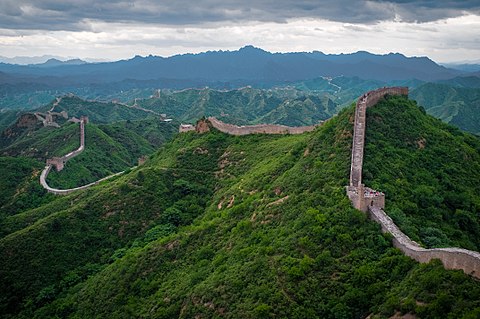
After the long rule of the Zhou dynasty, the Qin dynasty was formed by Qin Shi Huang. It is renowned as China’s first imperial dynasty. It ruled with no moral and had an authoritarian state that ruled by strict principles and rules. While it was the shortest living dynasty, from 221-206 BC, it still had a few advancements made during its period of rule. They infact constructed the first prototype of the Great Wall of China. While it wasnt fully complete at this point, it had been built majesticaly. The Qin Dynasty was also known for standardizing currency, and building roads and other structures. The fall of the Qin Dynasty was caused by the suppression caused by the strict measures and rules kept in place by the ruler. This, once again, caused people to revolt and this eventually led to the fall of the Qin Dynasty. The dynasty collapsed almost instantly after the emperor died.
The Han Dynasty is known as a golden age in Chinese history. It was founded by Liu Bang, also known as Emperor Gaozu. The Han dynasty lasted from 206 BCE to 220 CE. The main attraction of this dynasty is the formation of Confucianism. Confucianism is an ethical and philosophical system founded by Confucius, which highlights social harmony and virtues over spirituality and beliefs in godlike figures. Instead of beliefs in higher powers, it believes in personal relationships, like parent-child relationships. The Han also created a lasting centralised bureaucracy. Finally, this period marked the opening of the Silk trade route, which is a vital trading route used to transfer more items apart from silk. This era also included the creation of paper. The Han dynasty fell due to corrupt officials and warlords tearing it from the inside, and the revolt of the peasants, as always, was the final nail in the coffin.
The Tang Dynasty is a continuation of the golden era in China. It was fairly long-lived, from 618 CE to 907 CE. The Tang Dynasty was formed after the Han Dynasty because of Li Family, its founders. The Tang Dynasty also has many achievements, mainly characterized by its cosmopolitan culture, economic prosperity, and artistic achievements. The Tang Dynasty is also known as the “Golden Age of Chinese Poetry” and featured great poets like Li Bai and Du Fu, whose works are still famous to this day. The Tang Dynasty also continued work on the Great Wall of China, which was now used as a shield from enemies. The Tang also decreased inequality and made the dynasty’s civil service examination available to allow scholars who didn’t have family connections to enter the government. However, as all dynasties must fall, the tang dynasty fell, once more, due to revolts in the dynasty. This shattered central authority, and all this happened due to the mismanagement of the leader at the time. The leader was acting as a warlord, which caused the demise of the Tang Dynasty.
After the Tang Dynasty came the Song Dynasty. The Song Dynasty also lasted for a pretty long time, from 960 CE to 1279 CE. The Song Dynasty was divided into two periods, the Northern and the Southern. The Song Dynasty was founded by Emperor Taizu, and it made many advancements for its time. Firstly, it saw massive urbanization, or atleast you could say that for its time period. It also started the rise of Neo-Confucianism, a type of religion which was built on the base of Confucianism, which we learnt about earlier. It also made many advancements in gunpowder, printing, and maritime trade. It had a glorious run and also had a wonderful system of equality and justice. They eventually fell due to an invasion by the mongols.
The Yuan Dynasty was established following the fall of the Song Dynasty and was unlike any other dynasty that would follow throughout history. Founded by Kublai Khan, the Yuan Dynasty ruled from 1271CE until 1368CE. The first dynasty to be ruled by a foreign power (the Mongols), trade flourished massively under the rule of the Mongols as they had such extensive trade networks across Asia. The era also saw Marco Polo travel to China. Despite being rulers of the largest empire in the world at the time, the Mongols placed the native Chinese at the bottom of a social hierarchy that bred resentment. Combined with floods and famines that ravaged the nation during this time, the Mongols eventually fell to rebellion, leading to the rise of the Ming Dynasty.
The Ming Dynasty, existing from 1368CE until 1644CE, is one of the most well known dynasties of China. Founded by the peasant-turned-emperor Zhu Yuanzhang, the Ming Dynasty produced some of the most iconic constructions in Chinese history, such as the construction of the Great Wall of China and the Forbidden City in Beijing. Chinese explorer Zheng He led some of the largest maritime expeditions in history, vastly outclassing the maritime powers of Europe at the time. Yet, the expansion and growth of the nation led to economic decline, rebellion from the peasants of China, as well as an invasion of the Manchus from the north that would bring the dynasty to an end.
The last dynasty to rule China was the Qing Dynasty, established between 1644 and 1912 by the Manchus, who had invaded the nation from the north. However, unlike the Mongols, the Manchus blended into the culture of China and expanded the nation to its largest size ever. Yet, the Qing Dynasty had challenges that none of the other dynasties had faced. The Western nations invaded China, leading to the Opium Wars and the loss of power of China through the unequal treaties that were forced upon them. Additionally, China began to experience rebellions within its own nation during this time, as well. Due to the old fashioned and infrastructural resistance of the Qing Dynasty towards modernization, they were unable to survive into the future of China. In 1912, the last Qing Emperor, Puyi, would let go of the throne, marking the end of 2,000 years of Chinese dynasties.
And that marks the end of the Chinese Civilisation. Keep in mind this isnt about China the country, but the civilization. Thank you for reading!
By: Pradyun Reddy
Write and Win: Participate in Creative writing Contest & International Essay Contest and win fabulous prizes.
About the Author