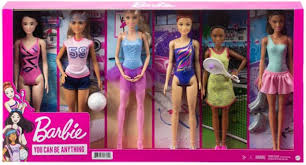
Imagine this: you’re a little girl in the mid 1900s. And like any other child, you’re bored. Not to worry; you have quite some options. Well, what toy would you like to play with? A toy pram to push around, a kitchen set to act out domestic roles or a baby doll that allowed you to learn skills of motherhood? I’m sure the issue is quite palpable. While little boys had plastic soldiers, toy trains, cars, building sets, trucks, etc. that gave them inspirations on what they could achieve and be, girls of impressionable age were stuck with toys that limited their future and aspirations to housewives and mothers. This continued to be the scene until the introduction of one glamorous and fashionable doll of her own world—Barbie!
Barbie was brought into the real world on March 9, 1959 by businesswoman Ruth Handler, co-founder of Mattel, a company that became the first to broadcast commercials for toys directly to children.
Barbie was named after Barbara Handler, daughter of Ruth Handler. A fact that is seen in Barbie’s real name being Barbara Milicent Roberts.
She was marketed as a ‘teenage fashion model’ with an adult body and interchangeable glamorous outfits. Her commercial included the catchy phrase of a young girl singing “Someday I’m going to be exactly like you, till then I know just what I’ll do… I’ll make believe that I am you!”
Although Barbie was doing fine alone, upon popular demand, Mattel released Ken in 1961, whose name is also taken from one of the Handler children. Ken has been Barbie’s longest standing romantic partner although they have never been married. Expanding Barbie’s social circle, Midge was introduced in 1963 as Barbie’s best friend. In the following year Barbie’s younger sister Skipper was also introduced.
But why did Ruth create the fashionista we know and love today? Well, it all happened on a vacation in Europe.
Ruth wanted to create an alternative for young girls. An adult doll. A wish that was heightened by seeing her daughter play with an adult paper doll. However, she was told no kid would want to play with a doll that had breasts.
That aforementioned European trip changed everything. In 1956 she saw an adult Lilli Doll on sale and noticed that kids were infact enamoured with it.
That was it. The push Ruth needed.
The first year sale of Barbie was enormous. She sold around 350,000 dolls, priced at $3 each.
From then on, it has mostly been an uphill ride for the blonde fashion doll.
Her popularity can majorly be linked to the fact that Barbie was the long awaited breath of fresh air in the female-targeted-toys market. She was tall, glamorous, fashionable, elegant—the perfect American girl.
It’s estimated that 2 Barbies are sold every second somewhere around the world. Now that’s popularity.
Till now, Barbie has inspired many works of art, cinema, music, literature and she’s not showing any signs of stopping.
In 1986, Andy Warhol famously created a portrait of Barbie titled ‘Barbie, Portrait of BillyBoy*’.
Photographers William Wegman and David Levinthal have also captured her in their lenses. Though their work leans more on drawing parallels between objectification of women and prevalence of dolls in pop culture.
In 2016, Museum of Decorative Arts, part of the Louvre, held an exhibition on Barbie that included more than 700 dolls.
While Barbie has been in more than 40 animated films, it wasn’t until 2023 that she went on the silver screen with Greta Gerwig’s live action film on the beloved doll.
Notable animated films include: Barbie: Princess Charm School (2011), Barbie as The Princess and the Pauper (2004), Barbie: The Princess & the Popstar (2012), ‘Barbie in the Nutcracker’ (2001), ‘Barbie of Swan Lake’ (2003), and more.
‘Barbie and the Ruth’ and ‘The Good, The Bad and The Barbie’ are among the few books on the radiant dream girl.
Barbie boasts a collection of more than 10,000 individual doll variations and more than a billion dolls sold over time.
A treat for consumerism? Yes. Iconic? Also yes.
While Barbie is iconic, she has also had moments of controversy; especially regarding diversity.
Even though she encouraged young girls to dream big, her appearance was often a topic for debate.
An hourglass figure, cinched waist, white skin, blonde hair, blue eyes—she was the embodiment of the American Dream that is often related to stars such as Marilyn Monroe, Grace Kelly, Zsa Zsa Gabor and more.
But that dream look cannot be a reality. It’s unrealistic and would be dangerous to anyone’s health.
It also stirred controversies during the 1970 women’s strike for equality with the slogan ‘I am not a Barbie Doll!’.
Despite the controversies, Barbie lives on, by adapting and taking accountability.
Barbie now has Down Syndrome Barbie, skin condition Barbies, wheelchair Barbie, POC Barbie and more. The world of Barbie keeps expanding, after all, there’s always room for more glamour in Barbie’s world.
Facts:
Ruth Handler turned to Jack Ryan for help with designing the doll. Ryan was an engineer who worked on guided missile systems used by the U.S. military. The Handlers convinced him to become head of research and development at Mattel.
Barbie’s first career was as a fashion model.
She has had more than 250 careers.
She has officially been President of Barbieland.
In 2022 NASA sent 2 Barbies to space to encourage young girls to join STEM careers.
Air Force Barbie hit shelves in 1990, dressed in an olive green jumpsuit and brown leather bomber jacket. She debuted shortly before Air Force pilot Lisa Wilson became the first enlisted woman to fly in a combat situation in January 1991.
Army Barbie debuted in 1989, a year in which the number of active-duty women enlisted in the U.S. military stood at 195,532—the highest number recorded by the Department of Defense between 1973 and 2010.
In 1962, less than a year after Alan Shepard became the first American to go to space, a young girl named Linda Halpern wrote to President John F. Kennedy. Like many Americans, Halpern was enraptured by the space race, from scientists’ use of futuristic technology to their exploration of new frontiers. She asked the president what she needed to do to become an astronaut herself. NASA’s Office of Public Services and Information responded on Kennedy’s behalf, replying, “Your willingness to serve your country as a volunteer woman astronaut is commendable. However, … we have no present plans to employ women on space flights because of the degree of scientific and flight training, and the physical characteristics, which are required.”
Around 18 years later Sally Ride became the first woman to go to space and Linda shared her letter with Ride, which she then kept in her file as a memoir.
Greiner and Hausser, the makers of the Lilli doll, sued Mattel for copyright infringement in 1961. Two years later the case was settled out of court, and in 1964 Mattel acquired the patents and copyright for the doll.
The world’s best-selling Barbie is Totally Hair Barbie, which has hair that reaches her toes. Totally Hair Barbie was released in 1992 and has sold more than 10 million dolls worldwide.
Saudia Arabia stopped sales of Barbie due to her dressing that went against their values.
In 1992, she became the first doll ever to appear in a computer game, “Barbie Fashion Designer.”
FAQs
How old is Barbie?’
She was created to be forever 19, making her technically immortal. Though her ‘real age’ would be around 65.
Why was Barbie created?
Barbie was created to give young girls an outlet to envision their futures. To tell them they could be anything (as said in Barbie’s iconic tagline).
Does she have a full name?
Yes! She does. Barbara Milicent Roberts.
Who is Ken to Barbie?
Ken’s full name is Kenneth Sean Carson. Introduced in 1961, Barbie and Ken have an on-and-off romantic history, officially reuniting on Valentine’s Day in 2011.
How many times has she run for President?
She has run for President of the United States seven times and breaking the glass ceiling, became president of Barbieland with an all female presidential team.
Does Barbie have parents?
Although she has no parents, she does have six younger sibilings. Her sisters include Skipper, Stacie, Chelsea (formerly known as Kelly), Krissy, Todd, and Tutti.
Has her body image always been the same?
For decades, Barbie received heavy criticism for promoting an unrealistic body standard. If she were a real person, her original impossible measurements and proportions would make walking and standing impossible. It was even said that with her level of body fat, a real woman wouldn’t be able to menstruate.
Where is she from?
She’s a small town girl. She hails from the fictional town of Willows, Wisconsin.
Does she have pets?
Yes. A lot. Barbie has owned more than 40 pets, including 21 dogs, 14 horses, three ponies, six cats, a parrot, a chimpanzee, a panda, a lion cub,
a giraffe and a zebra.
And with that, the Barbie legacy lives on.
By: Sharvi Sonali
Write and Win: Participate in Creative writing Contest & International Essay Contest and win fabulous prizes.
About the Author