Introduction: Why the Lifting Equipment You Choose Matters More Than You Think
In a busy manufacturing workshop, time lost waiting for a shared overhead crane is time that erodes margins. A single workstation that handles 80 lifts per day — each delayed by 30 seconds because the bridge crane is occupied elsewhere — bleeds roughly 40 minutes of productive time every shift. Multiply that across departments, across years, and the cost becomes structural.
This is why more plant engineers and operations managers are taking workstation-level lifting seriously. And among the range of solutions available, the floor mounted jib crane has emerged as one of the most consistently effective tools for eliminating those micro-delays, reducing ergonomic injuries, and delivering localized lifting power wherever it is needed — without rebuilding the entire crane infrastructure.
This guide covers everything a facility decision-maker needs to understand: how floor mounted jib cranes work, where they perform best, the engineering factors that determine a correct specification, how to maintain them, and what to look for in a supplier.
1. What Is a Floor Mounted Jib Crane?
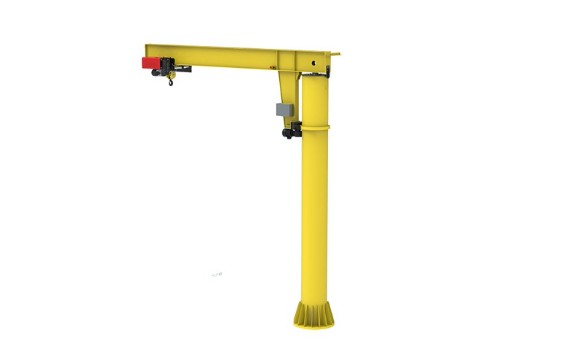
A jib crane is a type of material handling equipment characterized by a horizontal arm (the jib or boom) that rotates around a vertical axis to move loads within a defined arc. The floor mounted variant — sometimes called a freestanding jib crane or pillar jib crane — is anchored directly to a reinforced concrete foundation rather than to a building wall or column.
This structural independence is the defining feature. Because the crane creates its own foundation, it can be installed anywhere on the shop floor where adequate concrete exists or can be poured. It does not depend on the building structure, does not impose lateral loads on walls, and does not require expensive structural reinforcement of existing infrastructure.
The basic anatomy of a floor mounted jib crane includes:
- Vertical mast (column/pillar): The primary structural element, anchored to the foundation via embedded anchor bolts or a base plate. It must resist the bending moment created by the cantilevered load at full reach.
- Horizontal boom (jib arm): The cantilever beam from which the hoist trolley travels. The boom length determines the crane’s working radius — typically ranging from 3 metres to 10 metres depending on design.
- Slewing mechanism: The bearing assembly that allows the boom to rotate. Manual slewing relies on the operator pushing the arm; motorized slewing uses an electric drive for powered rotation.
- Hoist and trolley: The hoist (electric chain hoist, wire rope hoist, or pneumatic hoist) travels along the boom to position the load horizontally. Together with vertical lifting, this gives the operator full three-axis control within the crane’s coverage zone.
- Foundation and anchor system: Often the most critical and underappreciated element. The foundation must transfer bending moments, shear forces, and axial loads safely into the ground.
2. The Market Context: Jib Cranes in Global Industry
The jib crane market is expanding steadily. Industry analysts project the global jib crane market to grow from approximately USD 3.6 billion in 2026 to USD 5.8 billion by 2036, driven by continuous capital investment at the factory and workshop level — not by large infrastructure megaprojects, but by individual workstations and maintenance bays across thousands of facilities.
This growth trajectory reflects a broader shift in how manufacturers think about material handling. The focus is moving from centralized, high-capacity systems toward distributed, point-of-use lifting solutions that reduce dependency on shared equipment and empower individual operators. Floor mounted jib cranes sit squarely in this trend — they are precisely the kind of targeted investment that delivers measurable ROI at the workstation level.
The Asia Pacific region currently leads in market volume, while growing industrial bases across Southeast Asia, South Asia, and emerging manufacturing economies are driving rapid adoption of workstation lifting equipment in new facility builds and retrofits alike.
3. Key Applications by Industry
Understanding where floor mounted jib cranes perform best helps define whether they are the right solution for a given facility.
Automotive Manufacturing
Assembly stations that require repeated positioning of engine components, gearboxes, doors, or body panels are natural candidates. A Floor Mounted Jib Crane positioned at a trim or final assembly station allows operators to maneuver components into tight tolerances without manual lifting — reducing injury risk and improving cycle time consistency. Because the crane is fixed to the floor, it does not interfere with the overhead conveyor systems that run throughout most automotive plants.
Metal Fabrication and Welding Workshops
Fabricators need to position plate, beam, and weldments precisely at the work table — and then reposition them repeatedly as work progresses. A jib crane at each welding bay gives the welder independent lifting capability without waiting for a facility crane. The 360° rotation of a floor mounted unit means the same crane that brought a component to the bench can also transfer it to a staging rack when complete.
Machine Tool Environments
CNC machining centers, lathes, and milling machines require precise loading of workpieces — often heavy castings or forgings — into fixtures. A floor mounted jib crane positioned adjacent to the machine allows one operator to handle this safely. This is particularly valuable for shift change and tooling setups, where time spent maneuvering parts manually is time the machine is idle.
Maintenance and Repair Facilities
Maintenance workshops — whether servicing industrial equipment, vehicles, or production machinery — need flexible lifting capability that can be repositioned to wherever the work is. Because a floor mounted jib crane covers a circular area around its mast, a single crane can serve multiple maintenance bays within its reach, providing coverage that wall-mounted alternatives cannot match.
Warehousing and Logistics
In receiving and dispatch areas, jib cranes assist with loading and unloading at fixed docks or workstations where pallet handling exceeds ergonomic safe limits. For items that are too heavy for a pallet truck and too awkward for a forklift, a jib crane provides the controlled, precision placement that other material handling equipment cannot.
Foundry and Heavy Process Industries
In specialized applications, such as aluminum foundries or steel processing, custom-engineered floor mounted jib cranes handle extreme loads and harsh conditions. These units may incorporate sealed bearings, heat-resistant coatings, and load capacities well above standard — one documented application involved a 360° rotating floor mounted jib crane custom designed for 18,000 lbs of molten trough handling in an aluminum foundry.
4. Floor Mounted vs. Wall Mounted: The Decision Framework
The most common comparison when specifying a jib crane is between floor mounted and wall mounted configurations. Each has genuine advantages; the choice should be driven by the physical environment and operational requirements, not by cost alone.
Wall Mounted Jib Cranes are anchored to a building column or load-bearing wall. They cost less to install when a suitable mounting surface already exists, and they do not occupy any floor footprint. However, they are limited to 180° of rotation (limited by the wall itself), their capacity is constrained by the structural capability of the mounting surface, and any change to the facility layout that moves or removes the wall affects the crane’s functionality.
Floor Mounted Jib Cranes offer:
- Full 360° slewing arc, providing maximum coverage within the working radius
- Structural independence — no reliance on building walls, allowing installation in open bay areas, away from perimeter walls, or in facilities with lightweight cladding
- Higher load capacity potential, as the foundation can be engineered to any specification
- Installation flexibility — the crane can be positioned anywhere sufficient concrete can be provided
- Easier facility reconfiguration — the crane can theoretically be relocated if the foundation design allows for removal
The trade-off is the floor footprint consumed by the mast and the requirement for a properly engineered foundation. In space-constrained environments where every square metre of floor space counts, wall mounted alternatives may be preferable despite their operational limitations.
For open-plan workshops, facilities without suitable structural walls, or applications requiring full 360° coverage, the floor mounted configuration is almost always the correct choice.
5. Engineering Specification: What Must Be Calculated Correctly
Incorrect specification is the leading cause of premature jib crane failure and safety incidents. These are the engineering factors that require proper analysis — not estimates.
5.1 Rated Load Capacity
The rated load capacity must reflect the maximum load the crane will be asked to lift, including the weight of the hoist itself, slings, shackles, and lifting attachments. A common mistake is specifying capacity based on the net component weight and forgetting the rigging. Add a minimum 20–25% margin above the maximum expected lift weight for proper reserve.
5.2 Duty Classification
Cranes are classified by duty cycle — how many lifts per hour, at what fraction of rated capacity. Under FEM (European standard) classification, cranes are rated from M1 (very light, infrequent use) through M8 (very heavy, near-continuous use). Under CMAA (North American) classification, the equivalent range runs from Class A through Class F. A crane specified for light duty but operated in a medium or heavy cycle will experience accelerated structural fatigue and premature failure of bearings, welds, and the boom. Match the duty classification to the actual operating cycle with a realistic assessment of daily lift frequency and typical load fraction.
5.3 Foundation Design
This is where most errors occur and where the consequences are most severe. A floor mounted jib crane transfers significant bending moment — not just vertical load — into the foundation. The mast acts as a cantilever, and the horizontal component of the reaction at the base grows with load and boom length. Foundation design must account for:
- Soil bearing capacity and ground conditions
- Concrete strength (typically C25/30 minimum or equivalent)
- Anchor bolt specification: diameter, embedment depth, edge distance, and group spacing
- Moment arm from the crane base to the foundation centroid
- Dynamic load factors for crane class
An undersized foundation will allow the mast to rock, creating oscillation that degrades the slewing bearing, fatigues the base welds, and ultimately risks structural collapse. Always obtain a foundation design from a qualified structural engineer using the actual crane loads provided by the manufacturer.
5.4 Boom Length and Hook Coverage
The effective working area of a jib crane is a circle with radius equal to the boom length, centered on the mast. However, the usable area is reduced by the mast diameter itself (the hook cannot travel all the way to the mast centerline) and by any physical obstructions within the swing arc. Calculate the actual useful coverage by mapping the work zone against the crane geometry before finalizing boom length.
5.5 Hook Height
The height under the boom at the maximum lift point determines the maximum load height and the available hook travel. Calculate this based on the height of the load at its tallest handling position, the sling length required, the hoist collapsed height, and any required clearance above the load.
5.6 Slewing Bearing and Rotation Mechanism
The slewing bearing is the most mechanically critical component in a jib crane. It must handle the combined effect of the vertical load (weight of boom, hoist, and lifted load) plus the horizontal forces generated by acceleration, wind (for outdoor installations), and manual pushing. Bearing selection must account for the dynamic load spectrum across the expected service life. A heavy-duty tapered head bearing with cam follower rollers provides superior performance for high-cycle applications compared to plain bearings.
6. Hoist Selection and Integration
The choice of hoist affects not only the lifting performance but also the structural demands on the crane and the ergonomics of operation.
Electric Chain Hoists are the most common selection for capacities up to approximately 5 tonnes. They offer good speed control, compact dimensions, and straightforward electrical integration. For jib cranes, the hoist weight affects the boom structural calculation — heavier hoists increase dead load at the tip.
Wire Rope Hoists are preferred for higher capacities and where multi-layer drum winding is required for extended lift heights. They are mechanically more complex and require more maintenance attention (rope inspection, drum condition, rope anchorage), but they provide superior performance at the top end of the capacity range.
Pneumatic Hoists are used in environments where electricity presents a hazard — paint spray booths, chemical processing areas, or zones with explosive atmospheres. They require a clean, dry compressed air supply and a suitable pressure at the hoist inlet.
The trolley design matters as well. For manual travel along the boom, ensure the trolley wheel design is compatible with the boom flange geometry and that rolling resistance is low enough for comfortable operation. For motorized travel, the drive system must be rated for the duty cycle and properly protected against the environment.
7. Safety Standards and Compliance
Jib cranes are subject to regulatory oversight in all major industrial jurisdictions. Compliance is not optional, and selecting equipment that meets recognized standards protects both personnel and the organization.
Key standards applicable to floor mounted jib cranes include:
- ASME B30.12 (USA): Covers the construction, installation, operation, inspection, testing, and maintenance of jib cranes. ASME standards are voluntary consensus standards but are referenced by OSHA in enforcement actions and are treated as the accepted standard of care by courts and insurers.
- FEM 1.001 (Europe): General principles for the design of cranes including overhead, gantry, and jib cranes. Provides structural requirements, safety factors, and load handling device specifications.
- ISO 4301 (International): Classification of cranes by duty.
- EN 13135 / EN 13001 (Europe): Component and structural safety requirements.
A compliant crane installation should include load test documentation (typically 110–125% of rated capacity), structural calculations for both the crane and foundation, an as-built inspection report, and operator training records. These documents should be retained for the life of the equipment.
8. Maintenance: The Inspection Cycle That Extends Service Life
A jib crane that is properly installed but not maintained will fail — the only question is when. A structured maintenance program prevents this and extends service life considerably beyond that of neglected equipment.
Daily Inspections (Pre-Shift)
Before each operating shift, the operator should perform a visual and functional check covering:
- General visual inspection for visible damage, cracks, or missing components
- Hoist chain or rope condition — look for visible kinks, corrosion, or broken strands
- Hook condition and safety latch function
- Pendant or radio control functionality — verify all directions and speeds respond correctly
- Emergency stop function — confirm the E-stop cuts power immediately
- Unusual noises or vibration during the first test lift of the shift
This pre-shift check should take no more than 10–15 minutes and is the single most effective intervention for catching developing problems before they become failures.
Monthly Inspections
Monthly checks go deeper, examining:
- Slewing bearing play and lubrication — excess play indicates bearing wear
- Anchor bolts and base plate — check for movement, cracking of surrounding concrete, or corrosion
- Boom and mast welds — look for cracking at stress concentration points, particularly at the mast-to-base junction and the boom-to-slewing connection
- Trolley wheel wear and track condition
- Electrical connections, cable festooning condition, and control panel
Annual Inspections
Annual inspections should be conducted by qualified technical personnel and cover full structural assessment, load test verification, hoist brake function under load, and compliance documentation update. For high-duty cranes, more frequent formal inspections may be required by the applicable standard.
A well-maintained jib crane can reliably serve 15–20 years of industrial operation. A poorly maintained one may fail structurally within 5 years under moderate duty, with consequences that range from equipment damage to fatal injury.
9. Evaluating and Selecting a Supplier
The jib crane market ranges from premium-grade manufacturers with full engineering capability to commodity suppliers offering uncertified equipment with minimal documentation. The consequences of choosing the wrong supplier are borne by the buyer — not the supplier — when equipment fails.
When evaluating a jib crane supplier, examine:
Engineering Capability
Does the supplier provide structural calculations for both the crane and the foundation? Can they customize capacity, boom length, height under boom, and slewing arc to the specific application? Generic catalogue equipment rarely fits a real facility perfectly; the ability to adapt specifications matters.
Material and Manufacturing Quality
Examine the specification of the boom section — is it a recognized structural steel profile with adequate section modulus for the applied moment? Are welds full-penetration at critical joints? What surface treatment is applied for corrosion protection? These details determine service life.
Certification and Documentation
A reputable supplier delivers load test certificates, structural calculations signed by a qualified engineer, dimensional drawings, and operating and maintenance manuals as part of the standard package. Suppliers who treat these as extras or who cannot produce them should be disqualified.
Compliance with Standards
Confirm that the crane is designed and manufactured to a recognized standard — ASME, FEM, or equivalent — relevant to the buyer’s jurisdiction. Ask which specific edition of the standard applies.
After-Sales Support
Spare parts availability, technical support access, and maintenance documentation quality all matter for long-term ownership cost. A crane with proprietary components and no local parts availability creates maintenance exposure that offsets any initial cost savings.
10. The Economic Case: What Does the Investment Actually Return?
The business case for a floor mounted jib crane is not complicated, but it is often poorly quantified. Here are the three primary value drivers:
Throughput Improvement
When a workstation has its own dedicated lifting capability, operators do not wait for a shared overhead crane. In facilities where the overhead crane serves many users, competition for crane time is a significant and poorly tracked source of delay. A dedicated jib crane at a high-throughput station returns its purchase price in productivity improvement within months in many applications.
Injury Reduction
Manual handling injuries — sprains, strains, and musculoskeletal disorders — are among the most common and most costly workplace injuries in industrial settings. They generate direct costs (medical, compensation, lost time) and indirect costs (retraining, reduced output during recovery, morale effects). A jib crane that eliminates repeated manual lifting of loads above 15–20 kg at a workstation directly attacks this injury category. The reduction in injury-related costs alone frequently justifies the capital expenditure within the first two to three years.
Capital Efficiency
Extending an existing overhead crane system — adding a new bay, increasing capacity, or extending runways — is expensive. A floor mounted jib crane serving a single workstation or small cluster of stations can deliver targeted lifting capability at a fraction of that infrastructure cost, without the lead time of structural modifications.
Conclusion: Precision Investment for Industrial Efficiency
The floor mounted jib crane is not a universal solution — it is a precisely targeted one. It solves the specific problem of localized, repetitive lifting at fixed workstations where centralized overhead systems are either unavailable, over-specified, or simply too slow to serve effectively.
For facility engineers, the value is in the precision of the fit: a correctly specified, properly installed, and conscientiously maintained jib crane delivers predictable lifting performance for the life of the equipment. For operations managers, the value is in the floor-level impact: fewer delays, fewer injuries, and lower long-term cost of material handling.
Getting the specification right — foundation, capacity, duty classification, hoist selection, and safety compliance — requires working with a supplier who treats engineering rigor as standard practice, not an optional service. The right equipment, from the right partner, makes the difference between a crane that pays back its investment many times over and one that creates problems from the first year of operation.
Write and Win: Participate in Creative writing Contest & International Essay Contest and win fabulous prizes.
About the Author