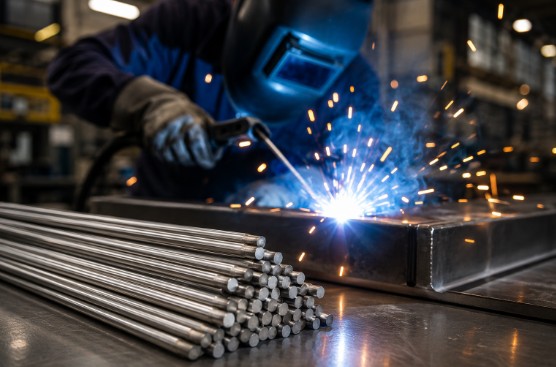
Maintaining high throughput in production metalworking depends heavily on the predictability of your joining processes. For facilities operating under tight schedules, a single defective joint can halt an entire assembly line. Achieving uniform mechanical properties across every component requires precise consumable selection. Utilising a high-grade stainless steel electrode ensures that structural joints withstand rigorous stress testing without exhibiting structural defects.
Industrial manufacturing costs escalate rapidly when rework becomes a regular necessity on the shop floor. Many structural failures trace back to erratic arc behaviour and poor slag release during fabrication. If your consumable metallurgy is inconsistent, your final joints will suffer from cracking, porosity or premature failure. Securing dependable shop consumables shields your business from these costly operational bottlenecks.
Key Contributions to Production Welding
Production welding demands stable electrical characteristics to ensure uniform penetration throughout long manufacturing shifts. The composition of your flux coating dictates how efficiently the metal transfers across the arc:
- Arc Stability: A premium coating provides a smooth, concentrated arc that minimises spatter during high-amperage operations.
- Slag Removal: High-quality flux formulations produce a self-peeling slag layer that protects the hot metal from atmospheric contamination.
- Porosity Prevention: Advanced moisture resistance in the electrode coating eliminates hydrogen pickup, stopping internal gas pockets from forming.
- Uniform Metallurgy: Choosing an engineered stainless steel electrode guarantees a precise chemical balance between chromium and nickel.
- Thermal Control: Balanced core wires distribute heat evenly, preventing localised overheating and grain growth in the base metal.
Minimising arc disruptions helps manual operators and robotic systems maintain identical travel speeds across every single component.
Material Versatility and Feed Efficiency
Modern fabrication lines frequently encounter projects that involve varying metal thicknesses or complex joint designs. Production managers must balance speed with metallurgical integrity when filling deep grooves or completing vertical climbs.
While stick welding remains dominant for heavy assembly work, specific automated setups demand alternative feeding methods. In these high-speed scenarios, integrating a stainless steel filler wire allows automatic machinery to deposit metal continuously without stopping for rod changes.
Matching your core wire metallurgy to your base plates ensures that the finished seam mirrors the native corrosion resistance. Proper material selection prevents the formation of brittle phases within the heat-affected zone. This precise matching guarantees that the assembly handles both operational fatigue and environmental exposure without degrading over time.
Supply Chain Integration for Manufacturing Standards
Achieving reliable, high-performance welds requires absolute trust in your consumables supply chain. Forward-thinking manufacturers look for a single vendor to streamline their procurement processes. Sourcing from a one-stop shop for all stainless steel consumables eliminates operational friction.
Choosing a manufacturer like Superon Technik, with its advanced stainless steel welding rods and electrodes, ensures high-performance welding that meets the toughest fabrication and repair demands.
Operational efficiency improves significantly when your consumable supplier provides easy availability across India. This extensive network gives industrial buyers multiple purchasing options from local inventories without experiencing shipment delays.
By working with a comprehensive vendor, commercial traders can treat them as a sole partner for all their needs. This collaborative model means businesses do not have to commit to multiple dealerships or complex minimum order quantities.
Operational Guidelines for Flawless Seams
To achieve optimal results from premium consumables, workshop teams must follow standardised material handling protocols:
- Storage Control: Always store welding rods in climate-controlled ovens to protect the flux coatings from absorbing environmental moisture. Damp flux introduces hydrogen into the arc pool, which directly causes severe weld porosity and cracking.
- Surface Preparation: Clean the joint edges thoroughly to remove oil, grease, paint and rust before striking an arc. Any residual surface contamination will destabilise the welding arc and contaminate the chemistry of your finished seam.
- Parameter Calibration: Set welding power sources precisely according to the manufacturer’s data sheet to ensure balanced heat input. Incorrect voltage or amperage settings alter the deposition rate and lead to poor penetration profiles.
- Interpass Monitoring: Control the temperature between weld passes to prevent the stainless steel from losing its corrosion resistance. Keeping the interpass temperature low avoids microstructural distortion and stops heat-affected zone cracking.
Implementing these straightforward workshop habits maximises the protective chemistry of your chosen consumable and prevents costly project delays. This systematic approach guarantees clean finishes and structural integrity across every production shift.
Strategic Value of Consumable Standardisation
Securing consistent weld performance requires premium materials, standardised techniques and a reliable supply partner. Inconsistent consumables introduce unnecessary variables that threaten workshop productivity and inflate your long-term operational costs. Sourcing reliable alloys protects your production assets from structural failure while maintaining strict engineering standards. Adopting proven consumable protocols transforms manual metalworking into a highly controlled, repeatable industrial process that consistently meets strict client specifications.
Write and Win: Participate in Creative writing Contest & International Essay Contest and win fabulous prizes.
About the Author