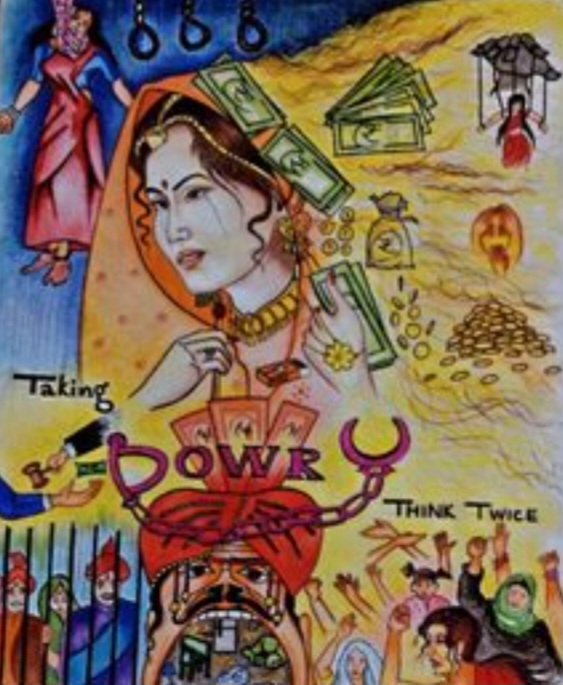
Every year, the “wedding season” in India is greeted with a frenzy of activity. Billions of rupees flow into the economy as families scramble for the best caterers, the most intricate lehengas, and the loudest brass bands. But beneath the layers of silk, marigold, and jasmine, a darker transaction is often taking place. For many young women, the wedding mandap isn’t the start of a partnership; it’s the closing of a business deal. When the music fades and the relatives depart, the “business” of the marriage begins. In thousands of cases annually, that business ends in a tragedy we politely label a “dowry death.” But let’s be honest: when a gift is mandatory, when it is negotiated behind closed doors like a corporate merger, and when its absence leads to violence, it isn’t a gift. It’s a ransom. The dowry system in India is a brutal extortion racket dressed up in tradition, and it is the most visceral evidence of industrious gender-based injustice in our modern world.
1. The Birth of a “Liability”
In India, the injustice doesn’t start at the wedding altar; it starts in the womb. Despite progress in education and technology, the shadow of dowry still dictates how we value a female life. From the moment a girl is born in a family that practices dowry, her existence is viewed through the lens of a future financial deficit.
This realization ripples through every aspect of her upbringing. It’s a silent, industrious form of discrimination. If a family knows they must eventually pay a massive sum to “marry her off,” they are subconsciously—or sometimes explicitly—less likely to invest in her. Why spend on a premium education or a specialized degree when that money needs to go toward a groom’s SUV or a pile of gold biscuits?
In our country, we often talk about the glass ceiling in the workplace, but for these girls, there is a “gold ceiling” at home. Their potential is capped by their “marriage value.” They are raised to be “marriageable” rather than capable. They are taught to be silent, to cook, and to “adjust,” because a woman with a strong opinion is seen as a liability in the marriage market. This is the first great injustice: the stripping away of a child’s dreams to pay for a groom’s greed.
2. The Architecture of a Dowry Death
We often treat dowry deaths like sudden, freak accidents—a “stove burst” in the kitchen or a tragic suicide. But a dowry death is rarely a random act of violence. It is a slow, calculated erosion of a woman’s dignity. It is a death by a thousand cuts.
It usually starts when the “honeymoon phase” ends. The groom’s family begins with subtle taunts. They compare the bride to the neighbor’s daughter-in-law who brought a bigger car. They complain that the refrigerator provided was “cheap” or that the cash amount given during Shagun was “insulting.”
When the bride’s parents can’t meet these escalating demands, the abuse shifts gears. The woman is isolated. Her phone is monitored; her visits to her parents are restricted. She is told she is a burden. This is the “industriousness” of the abusers—they work systematically to break her spirit so her family will pay up to “save” her. By the time we hear about a woman “falling” from a balcony, she has likely already endured a lifetime of misery in a few short months. The root cause is always the same: the belief that a woman’s life is worth less than the property she failed to bring with her.
3. The “Elite” Hypocrisy and the Big Fat Indian Wedding
The most sickening part of this reality is that it isn’t a problem of poverty. In fact, some of the most exorbitant dowries are demanded by the most “educated” people in India. Doctors, IAS officers, and engineers command the highest prices. In our society, we have turned education into a way for men to increase their “market rate.”
In these circles, dowry is a status symbol. A large dowry signals to the community that the groom is “premium” and the bride’s family is “respectable.” We have created a culture that celebrates greed under the guise of “tradition.” We attend these lavish weddings, admire the ten-course meals and the designer decor, all while knowing—deep down—that the bride’s father might have sold his ancestral land or taken out a predatory loan just to keep the groom’s family from frowning.
When we attend these weddings and stay silent, we are complicit. We are validating a system that says a man’s career belongs to him, but a woman’s education is just a way to lower her “price” or make her a more “valuable” servant to her new family. The “Big Fat Indian Wedding” is often built on the broken back of a father’s life savings.
4. The Trap: “Izzat” vs. Survival
Why don’t Indian women just leave? It’s a question that ignores the suffocating weight of social “honor” (Izzat). In our country, honor is a currency more valuable than gold.
A woman who returns to her parents’ home after a “failed” marriage is often seen as a source of permanent shame. Her presence is thought to “ruin” the marriage prospects of her younger sisters or brothers. When a woman calls home crying about abuse, the standard response from her own parents is often: “Beti, thoda adjust kar lo” (Daughter, just adjust a little). They tell her, “Only your shroud should come out of that house.”
This is the most tragic betrayal. The very people who brought her into the world become the wardens of her prison because they are terrified of what the neighbors or the “Samaj” (society) will say. This is the industriousness of social control. It uses shame to keep victims quiet and ensures that the cycle of extortion can continue without interference from the law.
5. The Silent Enablers: Neighbors and Relatives
We cannot ignore the role of the community. In India, a dowry harassment case rarely happens in a vacuum. Neighbors hear the screams. Relatives see the bruises. But the “industry” of silence is strong. People call it a “private family matter.” They don’t want to get involved in police cases. This silence is the oxygen that keeps the fire of dowry deaths burning. Every relative who asks, “So, what did you get in the wedding?” is an enabler. Every neighbor who ignores the signs of abuse is a silent witness to a crime in progress.
6. The Economic Impact of a Stolen Generation
If we look at this through a cold, economic lens, the dowry system is a massive drain on India’s potential. Think of the billions of rupees sitting in bank lockers as “wedding gold” or spent on one-day ceremonies. That capital could have been invested in startups, education, or infrastructure.
More importantly, it keeps women out of the workforce. If a woman is viewed as someone who will eventually be “sent away” with a payment, the incentive for her to become a high-earning professional vanishes. We are essentially sidelining 50% of our brainpower because we’re too busy calculating “marriage value.” India cannot become a global superpower if we are still treating half our citizens as liabilities to be traded.
7. The laws are there
The Dowry Prohibition Act has been on the books since 1961. We have Section 304B of the IPC (now BNS) specifically for dowry deaths. But you can’t police what happens inside a heart or a private home if the culture supports the crime.
To end dowry deaths, we need a radical shift in how we live:
From “Wedding Funds” to “Independence Funds”: Parents must stop saving for a one-day party and start saving for their daughter’s autonomy. A woman with a bank account and a career is much harder to trap.
The Power of “No”: The change won’t happen until our sons grow a backbone. A man who allows his parents to demand a dowry is essentially admitting he isn’t capable of supporting a family on his own. He is selling his dignity. We need a generation of men who find the idea of dowry insulting to their own masculinity.
Redefining Honor: We must teach Indian families that a divorced daughter is infinitely better than a dead daughter. Honor should be measured by how we protect our children, not by how much abuse they can tolerate in silence.
Community Accountability: If a family is known to harass a bride, they should be socially boycotted. We need to stop giving “respect” to people who use their sons as a way to extort money.
Conclusion: Beyond the Ransom
Traditions are not laws of nature; they are choices we make every day. Every time a young Indian couple decides to have a simple wedding without “exchange,” they are breaking a link in a centuries-old chain. Every time a father tells his daughter, “If they mistreat you, my door is always open,” he is saving a life.
It is time we stopped treating daughters like a debt to be settled and started treating them like the human beings they are. The “industry” of dowry must be shut down—not just by the courts, but by a collective refusal to see women as anything less than equal.
We must stop burying our daughters because we were too afraid to break a “tradition” that should never have existed in the first place. India’s future doesn’t lie in the gold we give at weddings; it lies in the freedom we give to our daughters to live, to work, and to be loved without a price tag attached to their souls because every single woman deserves a life defined by dignity, respect, and the absolute right to safety.
By: Namishree Naferia
Write and Win: Participate in Creative writing Contest & International Essay Contest and win fabulous prizes.
About the Author