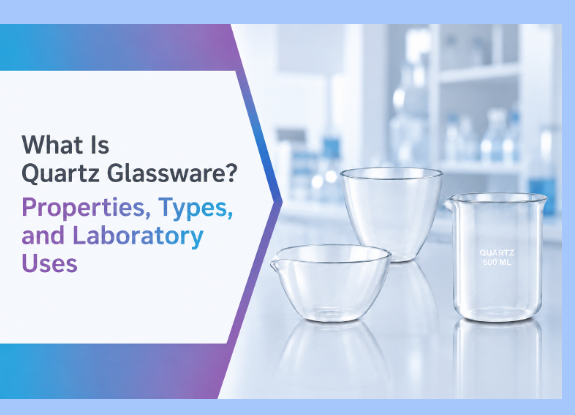
Quartz glassware is laboratory ware made from fused silica, a material with useful thermal, chemical, and optical characteristics. Its low thermal expansion supports dimensional stability and thermal shock resistance. High silica purity also supports specialised scientific applications requiring dependable material performance.
Laboratories use quartz vessels for heating, sample handling, analytical testing, and other specialised procedures. Available forms include crucibles, low-form beakers, Petri dishes, round dishes, basins, and volatile matter crucibles. Each design serves particular laboratory requirements and operating conditions.
What Is Quartz Glassware?
Quartz laboratory ware is produced from fused silica, which consists mainly of silicon dioxide. High-purity fused silica provides useful chemical durability and thermal performance. These characteristics suit scientific procedures involving elevated temperatures, controlled conditions, and purity-sensitive laboratory work.
Fused silica also has low thermal expansion, supporting dimensional stability during temperature changes. Its transparency also makes it suitable for certain scientific applications. Laboratories can therefore use quartz where thermal behaviour, chemical purity, or material visibility matters.
Key Properties of Quartz Glassware
The properties of fused silica determine how quartz vessels perform during laboratory procedures. Each characteristic supports a different scientific requirement.
The main properties include:
| Property | Scientific Significance | Laboratory Relevance |
| High Silica Purity | High-purity fused silica can contain 99.95% SiO₂, supporting applications where material purity is important. | This supports purity-sensitive scientific work. |
| Low Thermal Expansion | Quartz undergoes limited dimensional change during temperature variation. | This supports dimensional stability during thermal processes. |
| Thermal Shock Resistance | Low thermal expansion helps reduce dimensional changes during temperature variations. | Supports applications involving controlled heating and cooling. |
| Chemical Durability | Fused silica provides useful resistance under many laboratory conditions. | This supports suitable chemical and analytical procedures. |
| Transparency | Fused quartz provides useful transparency. | This can support suitable laboratory applications. |
Together, these characteristics make quartz useful for specialised laboratory applications involving heat, purity, chemical exposure, or transparency.
Main Types of Quartz Laboratory Ware
Quartz can be formed into several vessel designs, with each shape supporting specific laboratory functions and scientific methods.
Common laboratory forms include:
- Quartz Crucibles: Their vessel form supports high-temperature laboratory applications requiring thermal stability, chemical purity, durability, and dimensional accuracy.
- Low-Form Quartz Beakers: Their low form and spout support high-temperature reactions, heating, fusion, and convenient sample pouring.
- Quartz Petri Dishes: Their shallow design provides a suitable surface for laboratory applications requiring quartz’s thermal and chemical properties.
- Quartz Round Dishes and Basins: Their round form and spout support evaporation, heating, and controlled sample transfer.
- Quartz Volatile Matter Crucibles: These specialised crucibles include a lid and plunger for high-temperature analysis involving volatile substances.
Laboratory equipment manufacturers, such as Borosil Scientific, offer quartz crucibles, low-form beakers, Petri dishes, round dishes and basins and volatile matter crucibles for different laboratory applications. Borosil Scientific quartzware is made from fused silica containing 99.95% SiO₂, supporting applications where material purity is important. These designs show how vessel geometry and material properties can complement each other during heating, analytical and sample-handling procedures.
Laboratory Uses of Quartz Glassware
Quartzware supports laboratory applications where vessel design and material performance must match defined experimental and analytical conditions.
Relevant laboratory uses include:
- High-Temperature Processing: Quartz crucibles support laboratory applications where thermal stability and chemical purity are important during high-temperature work. For example, Borosil Scientific’s quartz low-form beakers can withstand temperatures up to 1100°C and are suitable for high-temperature reactions, heating and fusion processes.
- Heating and Fusion: Low-form quartz beakers support high-temperature reactions, heating, and fusion processes under appropriate laboratory conditions.
- Volatile Matter Analysis: Specialised volatile matter crucibles provide a suitable vessel for high-temperature analysis involving volatile substances.
- Sample Handling: Quartz beakers, dishes, and basins provide different vessel forms for holding, processing, heating, or transferring suitable samples.
- Related Filtration Work: Some laboratory procedures may require separate filtration media, such as a glass fibre filter, for sample clarification or particle retention, depending on the analytical method.
Choosing the appropriate vessel form helps align laboratory apparatus with the temperature, sample characteristics, analytical purpose, and procedure involved.
How Quartz Properties Support Laboratory Uses
Matching laboratory requirements with quartz properties helps explain why particular quartz forms suit specific scientific and analytical procedures.
Key relationships include:
| Laboratory Requirement | Quartz Property | Relevant Application |
| Elevated Temperature | Thermal stability | Heating and fusion processes |
| Temperature Variation | Low thermal expansion | Controlled thermal cycles |
| Purity-Sensitive Work | High silica purity | Specialised sample processing |
| Chemical Exposure | Chemical durability | Suitable analytical procedures |
This relationship helps laboratories consider material behaviour alongside vessel design when identifying an appropriate form for a particular scientific procedure.
Conclusion
Quartz laboratory ware combines high silica purity with useful thermal, chemical, and optical characteristics. Different vessel forms support distinct laboratory functions, including heating, fusion, sample handling, and volatile matter analysis. Matching each form with its intended process supports appropriate laboratory use.
Understanding vessel design, material behaviour, and operating conditions helps identify suitable quartz glassware for scientific work. Considering temperature, chemical exposure, purity, and process requirements helps laboratories match quartz forms with intended experimental and analytical applications.
Write and Win: Participate in Creative writing Contest & International Essay Contest and win fabulous prizes.
About the Author