Walk into most university solar labs from fifteen years ago and you’d find the same thing: a couple of flat-plate collectors bolted to a south-facing roof, a tank of hot water, and a thermocouple. That was it. The experiments were predictable. The learning was limited.
What’s happened since is genuinely interesting. Engineering departments have started asking harder questions not just “can we heat water?” but “can we generate industrial-grade heat, drive a chiller, or feed a steam cycle?” That ambition has pushed a lot of institutions toward concentrating solar, and specifically toward the parabolic collector trough, which sits at a sweet spot between achievable temperatures and manageable system complexity.
The Problem with Staying in the Low-Temperature Zone
Flat-plate systems top out around 80–90°C under decent conditions. That’s useful, but it doesn’t tell students much about what solar thermal can actually do in industry. Process heat for food manufacturing, chemical plants, and textile production often sits between 150°C and 300°C a range that flat plates can’t touch.
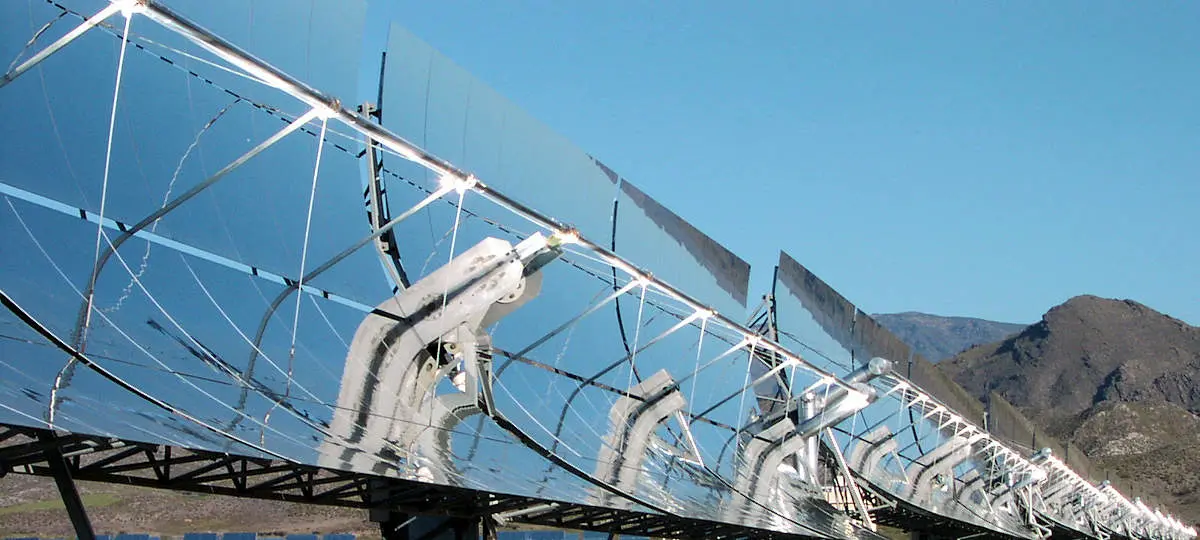
Parabolic collector systems change that equation. By focusing direct normal irradiance onto a receiver tube running along the focal line of a curved mirror, they can push heat transfer fluid temperatures well past 200°C, sometimes approaching 400°C in well-designed setups. That’s not just a bigger number. It opens up entirely different experimental territory: real steam generation, real thermodynamic cycle work, real absorption cooling.
Universities that have made this shift report something interesting: students engage differently with a system that operates at industrial parameters. There’s less “lab exercise” energy and more “this is an actual engineering problem” energy. The ambiguity of real performance data does something to a student that a pre-baked worksheet can’t.
What the Installations Actually Look Like
Take IIT-level institutions in India, several of which have installed parabolic collector systems specifically for direct steam generation research. The setups aren’t large by utility standards; aperture areas typically range from 20 m² to 150 m²but they’re large enough to produce meaningful performance data. Students work with actual tracking systems, actual heat transfer fluid loops, actual sensors that drift and need recalibration.
In Spain, the Plataforma Solar de Almería has served as a long-running collaboration point for European universities studying concentrating solar. Multiple institutions send research groups there each year. The International Energy Agency’s Solar Heating and Cooling Programme has documented consistent growth in concentrating collector deployments at academic research sites, with parabolic collector remaining the most widely used configuration.
American universities with energy engineering programmes have gone a slightly different route smaller installations, heavier instrumentation. The goal is publishable efficiency data, not headline capacity numbers. A 30 m² trough with 40 sensors tells you more than a 300 m² trough with four.
What Students Are Actually Learning
The educational case for parabolic collector technology isn’t just “higher temperatures, harder problems.” It’s more specific than that.
Operating a trough system forces students to deal with solar tracking, understanding why a single-axis tracker loses efficiency at high latitudes in winter, and what the trade-off looks like when you go dual-axis. They work with selective absorber coatings and learn why emissivity matters more at higher temperatures. They handle heat transfer fluids, synthetic thermal oils, pressurised water, molten salts in advanced setups and understand why fluid selection is an engineering decision, not a footnote.
Then there’s the instrumentation side. Most university trough systems now run with data acquisition setups that log irradiance, flow rate, inlet and outlet temperatures, and tracking angle in real time. Students take that data and compare it against the Hottel-Whillier-Bliss model or more recent ISO 9806 test standards. When the numbers don’t line up and they rarely line up perfectly the troubleshooting begins. That’s where real learning happens.
Some departments have pushed further, tying the trough output into a thermal storage tank and then routing that stored heat to an absorption chiller or a small Rankine cycle demo. For institutions building out this kind of integrated curriculum, the technical foundation of parabolic collector design optics, receiver geometry, energy conversion is worth having in front of students early, before they get into system integration.
The Headaches (and How Some Programmes Handle Them)
None of this is frictionless. Parabolic collector systems on a university campus come with real operational challenges. The tracker drives need periodic calibration. The heat transfer fluid circuit must be leak-free contamination from moisture or particulates degrades fluid properties over time. Civil foundations for the frame need to be done properly, or the tracking geometry goes off. And somebody has to do all this maintenance.
In many institutions, that “somebody” is a part-time technician with a full plate. Systems drift, performance degrades, and no one notices until a research group shows up expecting a functioning experiment.
The smarter programmes have done two things. First, they’ve negotiated proper commissioning and training support from their installation partners not just a handover manual, but actual on-site training for the technical staff. Second, they’ve made system maintenance part of the curriculum itself. Students rotate through a maintenance and diagnostics module. Keeping the system running is part of the grade. It sounds harsh; graduates say it was the most useful part of their degree.
Cost has been improving. The IRENA Renewable Power Generation Costs 2023 report shows concentrating solar thermal has undergone meaningful cost reductions over the past decade making campus-scale systems increasingly viable for institutions that previously couldn’t justify the capital outlay.
Why This Matters More Than It Might Seem
Industrial process heat, the sector where parabolic collector technology is most applicable represents around 20% of global final energy demand. Decarbonising it is genuinely hard. Solar PV can’t do it directly. Heat pumps struggle at higher temperatures. Concentrating solar thermal is one of the few technologies that can actually deliver clean heat in the 150–400°C range at a meaningful scale.
Engineers who graduate with hands-on experience on these systems are rare. Universities that take concentrating solar seriously aren’t just improving their lab specs. They’re producing people who can actually work on one of the harder decarbonisation problems out there and that, more than anything else, is what makes the investment worth making.
Write and Win: Participate in Creative writing Contest & International Essay Contest and win fabulous prizes.
About the Author