During a family vacation in Malaysia, our tour guide did not eat any food. He looked hungry, so we offered him food, but he refused, explaining that he was preparing for Thaipusam. We asked him what it was. He told us that it was a festival that honors Murugan, the God of War in Hinduism, who defeated evil forces. He asked us if we would participate in the festival with him. My family thought it was the perfect opportunity to experience Malaysia’s culture, so we agreed.
To help us prepare, he took us shopping to purchase yellow and orange Veshtis for me and my father and a Saree for my mother. We asked him why we had to wear clothes in orange and yellow. He explained that it is not mandatory, but they wear them because, in Hinduism, orange represents sacrifice and yellow represents purity. After shopping, he took us to our hotel and told us to go to sleep early for the preparation that starts at 3 a.m. He told us he would come get us at 2 a.m.
The next morning at 2 a.m., he knocked on our hotel door. Taking our traditional clothes, we followed him to his house. His family greeted us and told us that we had to take a shower, explaining that it was for washing away negative thoughts, beginning the pilgrimage with a pure mind, and showing respect before participating in a sacred festival.
My family took turns showering and changed into our Veshtis and Sarees. Then we joined their family prayer. We placed flowers before an image of Murugan, folded our hands, and bowed. They taught us to chant before praying for our personal wishes: “Vel Vel Muruga, Vetri Vel Muruga,” meaning “Murugan with the sacred spear, victorious Murugan.” Afterward, we received blessings from our tour guide’s mother and father. They wished the devotees strength and success.
With his family, we went outside and headed to Sri Mahamariamman Temple, the oldest Hindu temple in Kuala Lumpur. He explained that we would do our final preparations there before heading to Batu Caves, the final destination.
When we arrived at the temple, there were already thousands of people. Traditional Indian drums were roaring, people were chatting with their families or chanting religious chants, and the smell of incense and flowers hit my nose.
We couldn’t do everything the devotee families did in the temple because there were restrictions, but he helped us do most of it. We were able to carry milk and flowers, which were offerings to the god. At the entrance, we took off our shoes and washed our hands. We quietly went to Murugan’s shrine and offered milk and flowers. We folded our hands, bowed our heads, and said, “Vel Vel Muruga, Vetri Vel Muruga,” which is a special chant meaning “Murugan with the sacred spear, victorious Murugan.” Then we had time for personal prayers, which had to be done quietly. The priest placed Vibhuti, sacred ash that represents spiritual purification and the cleansing of negative thoughts, on our foreheads.
After praying, the tour guide told us to wait for them. It was time for piercing ceremonies and carry of Kavadis. Tourists can not participate because both of them are for ones who made religious vows; however, we were able to see and take pictures. They pierced their cheeks, tongues, skin on the chest, arms, and back. They pierced Vel, symbol of the sacred spear of Murugan, on their cheeks. On their tongues, they pierced a small metal rod or spear that represents self-control and devotion. They inserted needles or skewers on their chest, arms, and back.
The guide and his son each carried Kavadis. A Kavadi is a metal structure that devotees carry to demonstrate faith, sacrifice, and devotion. Small Kavadis weigh only a few kilograms and are made of wood or metal and decorated with flowers and cloth. Large Kavadis weigh between 30 and 50 kilograms, are made of metal structures, covered with peacock feathers, and decorated with images of Murugan. Some are even attached to the devotee’s body with small piercings.
After they got their Kavadis, we started walking to Batu Caves, which is one of the most sacred temples dedicated to Lord Murugan in Malaysia. The streets were filled with people heading in the same direction. The sound of Indian drums and bells, used to honor and welcome the deity, led the way. People chanted, “Vel Vel Muruga, Vetri Vel Muruga!” meaning, “Murugan of the Sacred Spear, Victorious Murugan!”
The tour guide’s family told us to stay with them. They explained that it was their duty as non-Kavadi holders to encourage their family members who carried Kavadis by giving them water, encouraging them with chants, and holding umbrellas. I held the umbrella for their son, chanting again and again. As I did, I looked around and saw that other families were doing the same thing. What was interesting was that every Kavadi was decorated differently. Of course, the components of the decorations were similar, but each Kavadi was unique.
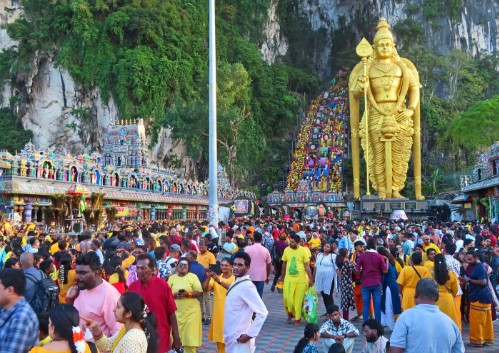
I do not know how long we walked, but when I was feeling tired and about to give up, the son tapped my shoulder and pointed forward. I looked and saw the enormous golden statue of Murugan standing in front of the caves. He told me, “We are almost there.” Suddenly, an unknown source of energy ran through my body—the curiosity of seeing the statue up close. I looked toward the tour guide. His eyes were red. I was worried that he was so tired that it showed in his eyes, but he was actually crying. I asked him why. He told me that he had become emotional because he thought he would be able to fulfill his vow. They believe that if they are able to complete the journey, their wish will come true.
I asked him again, “Is it over when we arrive there?”
He told us that there was one more difficulty we had to overcome: 272 steps.
When we arrived at the temple, we paused for a moment in front of the stairs, folded our hands, bowed our heads, and thanked Murugan for helping us complete the journey. It was surprising to see the colorful stairs. Since it was the stairs for the temple, I thought they would be colorless. Instead, they were colorful: green, purple, grey, blue, red, black, and white.The guide and his son took a deep breath. For others, it was easy to climb the 272 steps, but for them, carrying Kavadis made it much more difficult.
We started climbing the steps. With shaking legs, I climbed one step at a time, being cautious not to fall. I encouraged myself by thinking about how difficult it must be for the guide and his son. Looking straight ahead, I saw the golden statue of Murugan. I could not dare to blink; if I blinked, I thought I would turn to stone. Yet with every step i took, the statute seemed to move farther away. My vision became blurry; I couldn’t tell if it was from my tears or the sweat dripping from my forehead, turning the golden statue into a beam of bright yellow light. Step after step after step, and suddenly, there was no more. My father patted my back. I opened my eyes, and my sight was filled with the huge limestone cave and the shrine dedicated to Murugan, who seemed to be smiling gently down upon us.
We followed the family into the Temple Cave. We stood nearby while their son offered prayers to Murugan and completed his vow. Although we could not participate in the sacred ritual itself, we were close enough to watch every step. The family was emotional, and many people around us were celebrating the completion of their pilgrimages.
We followed the guide and his son as they sat down near the shrine. Family members gathered around them while experienced assistants carefully removed their Kavadis and piercings. I expected to see pain and panic, but instead I saw smiles and tears. The guide’s mother hugged her son, while the guide quietly folded his hands and thanked Murugan for helping him complete his vow. The pilgrimage was finally over. Families gathered around their loved ones, hugging each other and taking pictures to celebrate their success. The guide’s mother hugged both of them while tears rolled down her face.
Soon, everyone began sharing food and resting after the long journey. The guide invited us to sit with his family. As we ate together, they told us stories why completing a vow was so important to them. The journey itself is a way of sharing in the god’s experience, following what he went through in his battles. Before the start of the pilgrimage, they all make personal wishes, believing that God will grant them if they complete this spiritual experience.
Around us, traditional music played, children ran through the crowds, and families laughed together. Strangers congratulated one another, and the entire cave felt filled with relief, gratitude, and joy. What had started as a religious pilgrimage in the early hours of the morning had become a celebration of family, faith, and community. As the afternoon passed, we explored Batu Caves, took pictures with the guide’s family, and enjoyed the atmosphere. Looking around at the thousands of smiling faces, I realized that Thaipusam was much more than a festival. It was a journey that brought families and communities together through faith, sacrifice, and devotion.
Write and Win: Participate in Creative writing Contest & International Essay Contest and win fabulous prizes.
About the Author