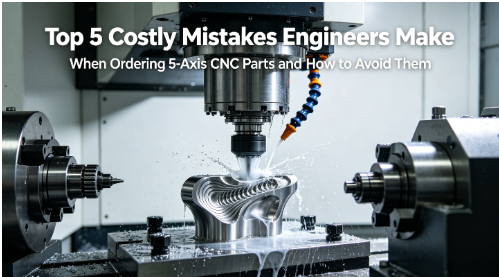
Introduction
Many times engineers or even procurement specialists come across a scenario where the seemingly competitive quote they receive for a complicated part eventually turns out to be full of dimensional defects, surface inconsistencies, and batch-to-batch variation in delivery. All these can easily be avoided if more attention were paid to the source of the manufacturing quote.
The problem here is an inadequate comprehension of the meaning of actual 5-axis capability. Most quotations are chosen based on price and claims made with regard to tolerance. Other important aspects such as process reliability, accurate dynamic machine control, material knowledge, and overall quality assurance are ignored. Industry giants such as Protolabs and Fictiv succeed due to their rigorous approach to risk management. This article identifies the five key hidden hazards of 5-axis CNC machining service sourcing and provides a comprehensive guide for selecting the right partner.
Is a Low Quote the Most Economical Solution for Complicated Parts?
The promise of a low upfront quote for Custom Complex Parts Online CNC Machining Quote is tempting, but in the case of complicated 5-axis machined parts, it is more of an illusion than anything else. While the price of a part may be lower than others, it is not the cost of ownership of that part. If it cannot pass inspection, hold up production in a plant, or even end up being defective when used in the field, its real costs exceed the savings on its price tag.
- The Unseen Costs Associated with Reworking and Poor Quality: A low quote usually translates into a low-cost manufacturing process. This usually means poor tool path optimization, lack of in-process quality checks, or employing generic work holding for parts which require customized approaches. This increases the risk of non-compliance with dimensional standards for the parts. The cost of sorting out such a situation can soon eat away all advantages of buying at a cheaper price.
- The Assembly Line Domino Effect: The effects of one non-conforming component cannot be confined to the machine shop. A piece which fails to fit when assembling can cause a stoppage of the whole assembly line, thereby putting on hold numerous workers and causing the delay in sending out the goods. Such losses incurred due to the inefficiency are seldom taken into consideration in the quote comparison but may be many times higher than the component itself. A supplier who has reliable process controls and embraces zero-defect manufacturing is like an insurance policy for smooth manufacturing processes.
- The Value of Transparent, Engineering-Led Pricing: It’s one of the characteristics of reputable suppliers to have an open and straightforward pricing policy where there’s no need for guessing what exactly goes into the quotation. Such suppliers include engineering services, design-for-manufacturability and quality assurance as a part of their quotes. It’s no longer an invoice, it becomes a document of manufacturing strategy with all possible risks involved and value added. As SME stresses, advanced procurement is based on Total Cost of Ownership instead of initial price.
How Do the Best Suppliers Achieve a True ±0.02 mm Tolerance?
While the machine’s specification sheet may list micrometer precision, actual tolerance in practice is achieved only through an integrated system of processes designed for quality production. The difference between theoretical precision of the machine and the precision in actual production lies in the environmental and process control methods applied to obtain Precision, Tolerances & Quality Inspection Basics.
1. Importance of Environmental and Process Stability
Temperature control is essential in producing tight tolerances on intricate parts. Slight temperature change may lead to expansion of the piece and the machine, thus, causing dimensional changes. The best machining companies operate under controlled temperatures. In addition, compensation tool systems take care of toolpath modification during cutting based on current measurement of dimensions of the part.
2. In-process Measurement and Feedback Control
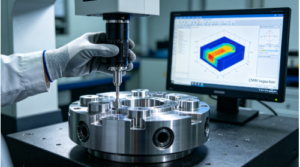
True accuracy must be achieved in real-time, during the actual machining process. By integrating on-machine probes (such as those made by Renishaw), an automated process measurement becomes possible, with dimensions being checked automatically at each machining cycle. Should there be any deviation, the system may automatically adjust the next part based on its calculations. This feedback loop turns the process control from an open to a closed loop, ensuring constant tolerances of ±0.02mm irrespective of any influencing factors.
3. Certifications as a Process Control Proof
The certifications such as AS9100D (for aerospace sector) and ISO 13485 (medical) are not just pieces of paper, but require the supplier to implement an official, verifiable process control process including the processes of calibration and traceability. An organization that possesses the certifications has the ability to control and monitor all of the aspects that might influence the accuracy of its products. Holding the certificates such as IATF 16949 and AS9100D confirms a supplier’s ability to control precision complex components.
What Is the Role of Deep Collaboration in Avoiding Manufacturing Dead-ends?
One of the most critical issues is that the majority of the most costly errors are made during the design stage before being implemented on the machine. The Design For Manufacturability (DFM) Mindset is the only method that guarantees no more manufacturing dead-ends. Collaborative DFM analysis at the quoting stage can help to uncover the possible challenges of Complex Geometry Machining before they turn into a disaster.
1. Identification of Common Design Challenges Early
A highly experienced DFM engineer will quickly identify features that cannot be machined properly. Such features include deep cavities with narrow corner radiuses requiring frail and fragile long tools, thin-walled elements that vibrate and distort, and the absence of clearly identified datum structures making tolerance holding difficult. Early detection helps significantly improve manufacturability without affecting functionality.
2. From Reactive to Proactive DFM Process
Reactive DFM process is when there is a detection of issues only after the quote acceptance, resulting in expensive changes to be made. On the other hand, proactive DFM process that is part of the quoting process is an engineering discussion. Engineers at the supplier firm study the design and offer better alternatives for geometry, location of features, and tolerance assignments.
3. Valuation of the Benefits of Early Engineering Participation
The ROI of strong DFM collaboration is quite high. According to research, implementing changes during the design stage is ten times to one hundred times cheaper compared to implementing changes during manufacturing. Effective collaboration in DFM contributes greatly towards improving first-time-right yield. The comprehensive guide on multi-axis CNC machining quotes that incorporating early engineering analyses can help reduce the costs of changes in design during the latter stages by up to 30%.
How to Make the Step from Prototype to Mass Production With Only One Partner?
Making the leap from a working prototype to efficient and affordable mass production is often referred to as the dreaded “valley of death” phase in the product development process. Moving partners from one stage to another poses risks, as process expertise obtained in the prototype manufacturing phase would be lost. Overcoming such hurdles requires working with a partner offering a seamless prototyping to low volume production pipeline.
- The Risks of Supplier Switching: Using two different shops to manufacture the prototype and mass-produced units is risky because the second shop will have to re-understand the part geometry, develop new toolpaths, and revalidate the entire manufacturing process. Even minor variations in equipment dynamics, philosophy regarding fixturing and even in skills levels can result in parts looking alike, but performing differently.
- The Strength of a Singular Digital Thread: With one provider providing their own multi-axis machining services, a continuous digital thread from initial prototype to final production units becomes achievable. The precise CAM programs, tool lists, inspection schemes, and quality metrics tested through the prototyping process are archived and used directly in the production process. This guarantees that the production process is a carbon copy of what the successful prototype process looks like, ensuring perfect continuity.
- Saving Time on Market Entry Through Effortless Process Transition: Such effortless transition of knowledge expedites time-to-market tremendously. There is no requirement for additional production qualification procedures because all necessary data obtained in prototype testing, such as optimal feed rates, fixture techniques, and inspection approaches, become available immediately in scaling up production processes. According to NIST, the establishment of a singular digital thread forms the basis of quality assurance within smart manufacturing practices.
Beyond the Machine: How Do the Support Services Distinguish Good Providers From Great Ones?
A 5-axis machine is only a means; the magic happens within the engineering environment surrounding the machine. The distinguishing characteristics of a premium provider are the in-depth understanding of the material sciences, extensive post-processing and inspection capabilities, and the advanced project management systems. These services will help you distinguish between Automotive, Aerospace, and Robotics Manufacturing Processes provider.
1. Advanced Material Expertise and Process Libraries
The process of machining one complex component made of Inconel 718 is entirely different from machining the same part using 7075 aluminum. An outstanding service provider will have an advanced process library with optimal parameters for machining all types of materials from the most popular alloys to unique super-alloys and engineering plastics. The process parameters are carefully calculated taking into account the properties of a specific material and preventing potential challenges.
2. Full Post-Processing and Metrology Capabilities
Precision machining can only go so far. A reputable partner would have a complete post-processing operation that would include processes such as heat treating, surface treatments, and unique coating applications. Importantly, they will also have highly developed metrology equipment, including multi-axis coordinate measuring machines, white light scanning technology, and surface profilers, to measure each key dimension and characteristic.
3. Supply Chain Transparency and Industry Compliance
The best partner will provide total visibility of its internal processes through its digital project management system by giving live information about the current state of jobs, inspections, and shipment information. In addition to that, they also have the knowledge and expertise related to industry compliance requirements in the automotive, aerospace, and medical industries. To determine the total capabilities of your potential supplier, you should ask more about their capabilities in providing 5-axis CNC machining services.
Conclusion
Success in sourcing 5-axis CNC machining services depends on the ability to largely move away from simply comparing machine lists and prices and instead switching to a more thorough approach that also takes into account the supplier’s engineering skills, their quality control processes, and their ability to manage risks. Recognizing and avoiding these common errors in cost understanding, tolerance creation, DFM processes, production scaling, and support structure will lead you to suppliers who ensure that your most complicated projects are done on time, within budget, and with the highest level of accuracy.
FAQs
Q: How long would a custom made 5 axis machined prototype typically take?
A: There is variation here, but industry leaders can deliver a prototype with standard features of metal materials in 5 to 10 business days. Note that lead time will include the DFM assessment, and a supplier who can provide rapid DFM feedback is an asset to this process.
Q: Is 5-axis machining able to handle metals and plastics with the same level of precision?
A: Yes, contemporary 5-axis machining centers can produce highly accurate results on both types of materials if the correct machining parameters are set. Using different materials will influence the choice of speeds, feeds, and trajectories. A professional supplier will generally have solutions that enable accurate working on different materials, including metals and plastics like aluminum and PEEK.
Q: What is the best way to prepare my CAD design file if I want an accurate 5-axis machining quote?
A: Ideally, provide a fully detailed 3D model (in STEP or IGES format) together with a complete 2D drawing with all dimensions (PDF or DWG). The 2D drawing is expected to detail all crucial dimensioning, surface finish, material selection, and finishing operations required.
Q: What are the main benefits of using 5-axis rather than 3-axis machining?
A: First and foremost, it allows single setup machining, which leads to improved precision and surface quality. Additionally, 5-axis machining makes it possible to create complex geometry, especially deep cavity machining and undercutting.
Q: What is the process to ensure quality for parts manufactured using 5-axis machines for important purposes?
A: Trusted suppliers use a process involving multiple stages of quality assurance. This includes the first article inspection (FAI) using CMM or optical scanning technology. For the batch production, statistical process control (SPC) tracks key measurements. Standards such as ISO 9001 and AS9100D require documentation of inspections, calibration, and traceability practices.
Author Bio
This article has been prepared through the experience and expertise gained through observations of the processes involved in precision manufacturing and supplying complex parts. The author’s company specializes in providing turnkey solutions of 5-axis CNC Machining to innovators across the fields of automotive industry, aerospace, and medical device makers under the standards of ISO 9001, IATF 16949, AS9100D, and ISO 14001. For project teams looking for partners for complex parts projects, LS Manufacturing provides expert evaluations.
Write and Win: Participate in Creative writing Contest & International Essay Contest and win fabulous prizes.
About the Author