Tree trimming is one of America’s most physically demanding and hazardous trades.
Arborists work at height, operate heavy machinery, and navigate unpredictable terrain every single day. For a tree trimming service, the risks don’t end when the crew packs up their gear.
A single accident can trigger a lawsuit, a property damage claim, or a worker injury case that drains your business overnight. This guide breaks down the safety protocols and insurance coverage every tree trimming service provider should have in place to protect their crew, their clients, and their bottom line.
Why Tree Trimming Is a High-Risk Trade
OSHA classifies tree trimming among the most dangerous occupations in the country. The fatality rate for tree care workers sits at approximately 110 per 100,000 workers, which puts it far above the average for most industries.
The hazards are real and varied:
- Falling branches or full trees during removal
- Chainsaw and heavy equipment injuries
- Falls from height while climbing or using aerial lifts
- Electrocution near power lines
- Vehicle accidents while transporting crew and equipment
Beyond physical injury, there’s a financial exposure that many smaller tree service businesses underestimate.
Property damage to a client’s roof, fence, or vehicle can easily run into the tens of thousands of dollars. Without the right coverage, that bill lands directly on the business owner.
| Quick Read: Tree trimming work carries one of the highest injury and fatality rates among American trades. Physical hazards include falling debris, equipment injuries, and power line proximity. Financial exposure from property damage and crew injuries can be severe without proper insurance. |
Building a Solid Safety Program for Your Tree Trimming Service
Safety isn’t just a moral obligation for a tree trimming service; it’s a business strategy. Insurers actively reward companies that document strong safety practices with better premiums and easier underwriting.
Pre-Job Hazard Assessment
Before any crew member picks up a chainsaw, a site walkthrough is non-negotiable. Identify utility lines overhead, assess the lean and weight distribution of the tree, and mark any underground utilities that could be damaged by heavy equipment.
A written hazard assessment for each job creates a paper trail that protects you legally and demonstrates due diligence to your insurer.
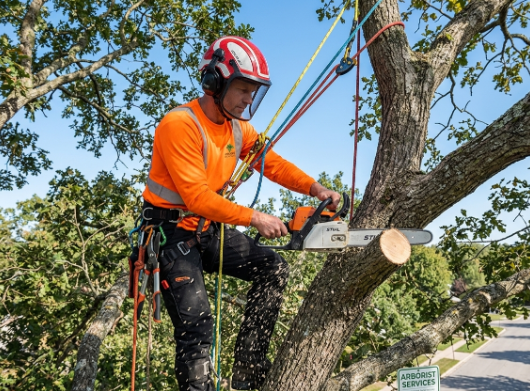
Personal Protective Equipment Standards
Every crew member working on a tree trimming job should be equipped with:
- ANSI-rated hard hat
- Cut-resistant chainsaw chaps
- Climbing harness rated for aerial work
- Steel-toed boots with ankle support
- High-visibility vests when working near roadways
- Eye and ear protection during active cutting
Shortcuts on PPE are one of the fastest ways to turn a minor incident into a serious injury claim.
Ongoing Crew Training
Certification through the International Society of Arboriculture (ISA) gives arborists a recognized credential and demonstrates that your team meets industry safety standards.
Regular on-site safety briefings, annual refreshers on equipment handling, and clear emergency protocols are equally important. A documented training program also strengthens your position when negotiating with insurance carriers.
| Quick Note: A documented safety program, mandatory PPE, and certified training reduce accident rates and can directly lower your insurance premiums. Insurers look for evidence of discipline and preparation before offering favorable terms to a tree trimming service. |
Types of Insurance Every Tree Trimming Service Needs
No two jobs are identical, and neither is the risk profile of every tree trimming service. That said, there are several core coverage types that every operation should carry, regardless of size.
General Liability Insurance
General liability is the foundation of any tree service insurance program. It covers third-party bodily injury and property damage that occurs during the course of your work. If a falling branch damages a client’s roof or a crew member’s equipment injures a bystander, general liability is what pays for it.
For residential work, a minimum of $1 million per occurrence and $2 million aggregate is standard. Commercial clients typically require higher limits, often $2 to $5 million per occurrence, and will ask for proof before they sign a contract.
Workers’ Compensation Insurance
Workers’ compensation is mandatory in most states for any tree trimming service with employees. It covers medical expenses, lost wages, and rehabilitation costs when a crew member is injured on the job.
Here’s the detail many business owners miss: the workers’ comp policy must specifically cover tree work. Some carriers allow companies to classify themselves as landscapers to reduce premiums.
But if a crew member is injured doing tree work under a landscaping classification, the claim may be denied, leaving the business owner personally liable.
Workers’ comp for tree trimming is expensive, running between $15 and $25 per $100 of payroll in many states, and in some markets rates have spiked significantly higher. That cost reflects the real risk involved. Skipping or underbidding it is not worth the exposure.
Commercial Auto Insurance
Tree trimming crews move daily, often with loaded trailers, chip trucks, and aerial lift vehicles. A personal auto policy will not cover accidents involving a vehicle used for commercial purposes.
Commercial auto insurance covers the cost of collisions, liability claims, and damage to your equipment in transit. Every vehicle in your fleet, including rented or leased trucks, should be listed on the policy.
Tools and Equipment Coverage
Chainsaws, climbing gear, aerial lifts, and stump grinders represent a significant capital investment. Tools and equipment coverage protects these assets from theft, damage, or loss whether they’re at a job site, in transit, or stored off-site.
This type of policy is sometimes referred to as inland marine insurance and is especially important for equipment valued over $10,000.
Commercial Umbrella Insurance
General liability and commercial auto policies have defined limits. When a catastrophic claim exceeds those limits, a commercial umbrella policy activates and covers the difference.
For tree trimming services taking on larger commercial contracts or high-value residential jobs, umbrella coverage provides an important extra layer of protection.
| Must Read: A complete insurance program for a tree trimming service includes general liability, workers’ compensation, commercial auto, tools and equipment coverage, and ideally a commercial umbrella policy. Each type addresses a distinct category of financial risk. |
Choosing the Right Insurance for a Tree Trimming Service
Not all insurance policies are built for tree care. A standard landscaping policy often excludes aerial work, chainsaw operations, and tree removal. Always verify that the policy language specifically covers arborist and tree trimming services, not just general landscaping.
Working with an insurer that understands the tree care industry makes a real difference. For tree trimming service providers looking for specialized coverage, getting insurance for tree trimming service through a program specifically designed for this trade ensures your policy matches the actual risk profile of your operations.
A few practical steps when evaluating coverage:
- Ask to see a sample policy and confirm it explicitly names tree trimming and arborist services
- Verify that workers’ comp is classified correctly for tree work, not landscaping
- Confirm that your equipment coverage extends to both on-site use and transit
- Check that commercial auto coverage includes all vehicles in your fleet, including non-owned or rented vehicles
Certificates of Insurance
Any reputable tree trimming service should be able to provide a certificate of insurance on request. Government contracts almost always require it. Commercial property managers expect it before work begins. And increasingly, residential clients are asking for it too.
Having your COI ready demonstrates professionalism and speeds up the contract process with clients who require proof of coverage.
Common Insurance Mistakes Tree Trimming Companies Make
Even experienced tree service operators make coverage gaps that only become visible when a claim is filed.
Misclassifying workers as independent contractors
Calling crew members independent contractors doesn’t automatically exempt you from workers’ comp obligations. Many states look at how the work is performed, not just the label. If a court determines your “contractors” are actually employees, you may owe back premiums and face penalties.
Letting a policy lapse between jobs
A gap in coverage, even a short one, can leave you exposed during a period when equipment is in transit, stored, or when a delayed injury claim surfaces from a previous job.
Relying on minimum policy limits
The minimum required coverage is often not enough to fully cover a serious accident. A single tree removal job gone wrong can generate a claim that exceeds a $1 million general liability limit quickly when property damage, medical costs, and legal fees are combined.
Not updating coverage as the business grows
Adding crew members, new equipment, or new service types like stump grinding or hazardous tree removal changes your risk profile. Inform your insurer whenever your operations expand.
FAQs
What insurance does a tree trimming service need at a minimum?
At a minimum, a tree trimming service should carry general liability insurance and workers’ compensation if they have employees. Most states mandate workers’ comp for any business with one or more employees. General liability protects against property damage and third-party injury claims, which are common risks in tree care work.
How much does insurance for a tree trimming service cost?
Insurance costs vary by business size, location, and coverage type. General liability for a small tree service can start around $45 per month. Workers’ compensation typically runs $15 to $25 per $100 of payroll, though rates in some states have been significantly higher in recent years due to the high-risk nature of tree work.
Does a tree trimming service need separate insurance from a landscaping company?
Yes. General landscaping policies often exclude aerial work, chainsaw operations, and tree removal. A tree trimming service needs a policy that explicitly covers arborist services. Using a landscaping-only policy for tree work can result in denied claims when you need coverage most.
Can a documented safety program lower insurance premiums?
It can. Many insurers offer better rates to tree trimming businesses that demonstrate formal safety training, proper PPE enforcement, and documented hazard assessments. A clean claims history combined with a proactive safety program makes your business more attractive to carriers and gives you better leverage when renewing or shopping for coverage.
Write and Win: Participate in Creative writing Contest & International Essay Contest and win fabulous prizes.
About the Author