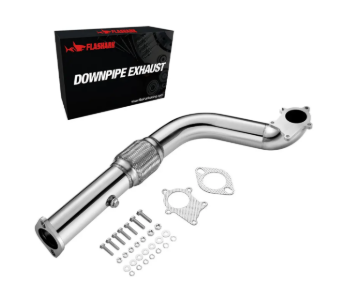
Car lovers still appreciate the 2000 Honda Civic to this day due to its reliability, light weight, and ease of modification. Whether you are personally looking to build a track car, weekend driver, or just a car to show off, one enhancement that makes the biggest difference is installing a high-flow Downpipe Exhaust. Doing so improves horsepower, throttle response, and overall driving experience. But how does a performance 2000 Honda Civic downpipe actually work? And why should you make the change? Let’s take a closer look.
Why The Downpipe Is Important For Your 2000 Honda Civic
As with any car, the downpipe is an integral part of your exhaust system as it is primarily used to remove the exhaust from the engine area. For stock owners of the 2000 Honda Civics, you’ll know that the factory downpipe comes set with cat con systems that are known to be quite heavy. Because of these two factors, the airflow will always be limited. This creates back pressure. This means that the engine becomes less efficient which robs the car of its stock power.
A high-flow Downpipe Exhaust will help you tackle these issues head on as the system consists of larger-diameter piping, mandrel bends for smooth airflow, and high performance catalytic converters, or cat-delete options for race applications. All of these enhancements mean that a 2000 Honda Civic downpipe improves the ability of the engine to remove exhausted gas which ultimately leads to better combustion and an increase in horsepower.
Performance Improvements: The Benefits of Using a High-Flow Downpipe
However, you can notice substantial changes in your 2000 Honda Civic performance by replacing the stock downpipe with an aftermarket Downpipe Exhaust. Let’s look into it:
- Improved Torque and Horsepower
A 2000 Honda Civic downpipe that allows high exhaust flow improves horsepower by 5-15+ (or even more) as it decreases backpressure and permits the engine to ‘breathe’ better. This is true for naturally aspirated engines as well. Turbo models (like those with B-series or K-series swaps) do even better, as the Downpipe Exhaust permits faster turbo spool, helping reduce lag.
- Increased Throttle Response
Less restriction on exhaust flow means a cleaner purging of exhaust gases from the engine, which translates to easier work for the engine, resulting in tighter acceleration and prompt power delivery, all of which are ideal in the mid-to-high RPM range. This is one of the noticeable differences drivers experience right after changing their 2000 Honda Civic downpipe.
- Improvement in Exhaust Sound
This is not usually the main reason to invest in a high-flow Downpipe Exhaust, but it does add an aggressive growl to your Civic, making the sound more noticeable with an aftermarket cat-back system. It is not as loud or unpleasant as some straight-pipe systems, making it more appealing when coupled with other upgrades.
Exhaust Downpipe Options for 2000 Honda Civics
While searching for a 2000 Honda Civic downpipe, also known as exhaust piping, you will come across the following options:
Catted Downpipes: These option includes a catalytic converter, allowing them to be used legally in most places while still enhancing performance. The inclusion of high flow cat converters allows a seamless exhaust flow which greatly increases performance when compared to stock catalytic converters.
Catless Downpipes: Most suitable for off-road applications, these are best for track purpose as they maximize exhaust flow by removing the catalytic converter (however, they may not pass emissions).
Turbo-Back vs. Cat-Back Systems: A complete Downpipe exhaust system can be part of an existing turbo-back system, typically used with boosted Civics, or it can fit to an already installed cat-back exhaust system.
Considering your purpose, set your goals first as some factors include needing to pass emissions tests, in which case a catted downpipe will be optimal for you. When unrestricted testing and chasing every horsepower, catless is ideal and will yield greater performance gains.
“O2 Sensor Compatibility” – Almost all aftermarket downpipes come with bungs for factory O2 sensors. But for some setups, especially catless ones, an extender or tune may be needed to avoid check engine lights.
“Fitment Issues” – Some cheap downpipes may need small cuts to fit around the chassis or other components. Higher quality options, like those from reputable brands, usually bolt right up.
“Exhaust Leaks” – Proper torque settings and new gaskets for the 2000 Honda Civic downpipe installation are critical to prevent leaks.
If the installation is too much of a hassle, trusted mechanics can do it within a few hours.
What Pros Owners Are Reporting
Most owner reports from different forums indicate that their 2000 Honda Civics saw improved acceleration, engaging driving experience, and performance fuel efficiency, with VTEC model owners enjoying the upgrades the most. The gains are even more substantial on turbocharged builds, with some turbocharged builds reporting more than 20 horsepower gains with quality Downpipe Exhausts.
Final Thoughts: Is the High-Flow Downpipe Exhaust Really Worth It?
If you want the most bang for your buck, a high-flow Downpipe Exhaust is going to give a 2000 Honda Civic a substantial attitude. It’s not too difficult of a modification and yields results. More power, better response, and a more refined engine ferocity are some of the perks.
While the stock 2000 Honda Civic downpipe does enable a daily commute, it has nothing on a good aftermarket Downpipe Exhaust. For a street racer, an autocross hopeful, or even a casual weekend driver, this is a must-do upgrade.
Conclusion
A 2000 Honda Civic showcases an unfulfilled need for intelligent alterations, and a high-flow Downpipe Exhaust fills that gap, especially considering Honda lovers. You don’t even need to break the bank. Changing the stock 2000 Honda Civic downpipe allows for better performance, snappier throttle response, and gets you a car that sounds like it means business.
Write and Win: Participate in Creative writing Contest & International Essay Contest and win fabulous prizes.
About the Author