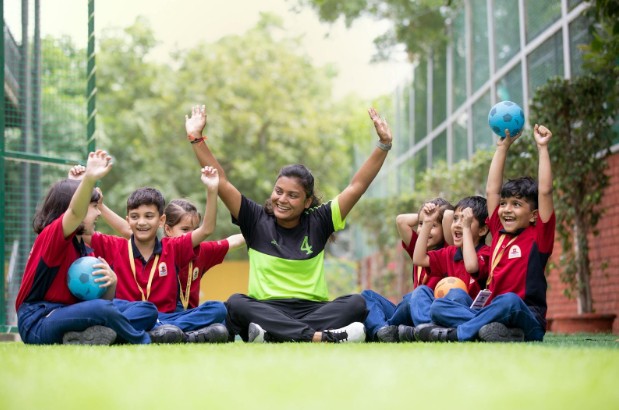
Play is not just fun or free time for children, it is how they understand the world, imagine their futures, and resist the limitations placed on them. When we watch how children play and what they imagine about play, we see their deepest fears and their strongest hopes.
During my 3rd week at Surya Gaon, I chose children’s play as my topic to explore more. As during my 2nd week I observed that children find play in any activity, if they are given a safe and resourceful environment. One of the incident was when children themselves asked me that if they can draw me? They asked me my name and tore a small piece of paper, wrote ‘S’ on that paper and started drawing. I have attached the drawing below and along with it, there is a small yellow welcome card for us.
In my report ahead I would use ‘A critical perspective on children’s right to play by Dr. Anandini Dar’ and RTE. I would mainly use quotes from her text and would unpack them and would use my observation as a support.
When I asked the children what they do during lunch break, I expected simple answers. Instead, I discovered that play was far more complex than I thought. Some children ate quickly and ran to games. Some brought out carrom and ludo boards. Some just drew. And when I asked one group why they were not playing, they said something that stayed with me: “Khelne mein man nahi lagta” (We don’t feel like playing). This relates to what dr. Dar’s more general claims that “children’s play and their right to play is intrinsically linked to their childhoods, affected by the sociopolitical and economic contexts in which they grow up” (p. 256). The phrase “khelne mein man nahi lagta” is not simply about boredom—it reflects how external pressures, whether from academic demands, lack of space, or internalized hierarchy, can diminish the very desire that defines childhood.
A drawing on a piece of paper
AI-generated content may be incorrect.
This simple phrase raises questions like why would children not want to play? What does it mean when the natural desire to play is missing? And what does it mean when children who do play are so eager that they rush through meals just to get to games faster?
Through this week of observations, I learned that play is not a luxury for children. It is an opportunity for the children to mix with their peers and if the students doesn’t play they miss a big chance to develop their emotional and social self. I noticed that children who played showed more energy, confidence, and connection with others. They laughed, argued, formed teams, and solved small conflicts. On the other hand, children who did not play stayed more silent and distant. In my opinion, this shows that play is not a small activity. It is central to a child’s emotional and social growth. When children miss play, they miss a chance to build friendships, express emotions, and develop their sense of self. Play is where childhood truly lives, and without it, something important remains incomplete.
Struggle for Playtime
The first thing I noticed was how quickly children ate. They rushed through their food, finished in minutes, and then ran outside shouting “First! Second!” as if there was a race to reach the playing ground.
At first, I thought this was just hunger, they needed to eat fast to have time to play. But then I understood something deeper. These children were not rushing because food was scarce. They were rushing because playing space and equipment were scarce. They eat fast because they know the break time is short. They eat fast because they might not get many chances to play if they do not hurry. This rushing behavior demonstrates what Dar calls the “co-generational production of play” (p. 255), where play is not simply given but must be actively negotiated within adult-imposed constraints of time, space, and institutional schedules.
This taught me something about priorities. Food fills the stomach, but play fills something else, something about being alive and free. Some children did not rush. Some brought out games like carrom and ludo. Some just drew quietly. And when I asked them why they were not running to play outside, some said, “Khelne mein man nahi lagta” (We don’t feel like playing).
It was said by children so young that the natural desire to play should still be burning inside them. Yet something had already learned them to not want it. Maybe it was exhaustion from school. Maybe it was the knowledge that they could not play what they wanted to play. Maybe it was something else, something about growing up in a place where play is not considered important or it could simply be that drawing was the only thing they wanted to do in their free time.
The importance of play was also visible in the school routine. Every morning, children had PT and physical exercises. They stretched, jumped, and moved together. These activities made them more active, refreshed, and mentally ready to learn. After movement, they appeared more focused and responsive in class. In my opinion, such physical activities prepare their body and mind to understand lessons better.
Imagination and Reality
One afternoon, I was interacting with a four-year-old boy. In that interaction he started telling me a story. In his story, his older brother had a torch. A tiger came to their roof. His brother shined the torch at the tiger, and the tiger’s eyes reflected the light. The tiger blinked, and then he made an eye-contact gesture to someone walking by. That person died. When I first heard this, I thought he was lying. It seemed too dramatic, too fantastical. A tiger on the roof? Someone dying from eye contact? I smiled politely, thinking he was making up things.
Then he told me another story. Pointing towards a farm saying, they had hidden a bone. One day, a snake ate it.
Later, I learned something that changed how I understood his stories. Tigers do actually come to their roofs. This is real. This is part of their world. The boy was not inventing a fantasy. He was telling me something true. This child was not entertaining himself. He was not wasting time. He was teaching himself about his world. He was learning what is dangerous and what is safe. He was learning the rules of his environment through storytelling.
I realized that this child was not telling me stories for entertainment. He was telling me stories from his life. These were real things that had happened or that he had witnessed. His imagination was not separate from his reality, it was an extension of it. This is what I had seen before with the older children, but here it was even clearer. Children do not imagine generic adventure stories. They imagine the world they live in, made slightly more dramatic, slightly more frightening, slightly more meaningful.
When he showed me stunts and told stories, he was practicing something important. He was making sense of his world by turning it into narrative. He was learning what is dangerous and what is safe. He was learning the rules of his environment.
Drawing on Katz’s research, Dar explains that “through play, children mimic their future adult roles, as they play games such as ‘house’ or ‘setting up a shop’” (p. 256). I also observed that children were mimicking their teachers and that how they are beaten, they would beat their children in similar way. I found it concerning that they are internalizing violent behavior but at the same time it was a form of play. But dr. Dar also states that “This chapter also urges us to move beyond a romanticized idea of play and understand the limits of the transformative power of play, so as to imagine a more critical perspective on the right to play” (p. 257). Even though this child’s storytelling shows impressive learning and courage, one have to understand that he has to confront with actual threats that kids in safer settings would never face. His play shows not only creativity but also the weight of growing up in not very safe environments.
Another incident was with a 7 year old boy, after observing him I asked him playfully that why does he always lie? He answered “hamesha ni bolt kbhi kbhi boring ho jata hu tb bolta hu”, this was a child saying, sometimes reality is boring, exhausting. Sometimes I need to make it more interesting. He was learning to sit still, to follow rules, to do what he was told. And sometimes, that was boring. So, he created stories to make his day less boring. He was adding color to a gray world. This child’s play was not wasting time. It was learning. It was survival training in the form of fun.
Power in Small Hands
I observed that children played with local resources. They played “oonch neech ka papada” and with mud, sticks and stones. One child had toys and he was just trying to flaunt his toys, he would sometimes give his toys to his friends willingly and takes them back anytime he wants, the little boy knew how to show his control over things which belongs to him. He was learning about ownership and control. The boy knew that these toys belonged to him. He knew that he could choose to share them or not. He knew that he could give them and take them back. This was not about being mean. For a child who might not have much control in his life—a child who has to listen to teachers, to parents, to older children, this moment of controlling his toys was important. It was a moment where he had power. Where his choices mattered.
Another child was given tomatoes and potatoes by his mother to play with while his older brother was in class. Tomatoes and potatoes become toys. When a child plays with a tomato, they are learning texture. They are learning weight. They are learning how things feel and move. They might be learning about rolling and bouncing. They might be learning about decay and change if they keep the tomato for a while.
When I asked them if they wanted to bring sports equipment from where will they get it, even if their parents doesn’t allow? They said, “if our parents don’t bring games for us, we will buy it with our own money” (“Apne paison se laenge”). There is acceptance. There is an understanding that not everything will be given to them. There is a kind of early growing up that starts very young. It shows that these children have already learned the connection between work and reward. They know that money comes from work. They know that work leads to the ability to buy things.
I realized that the most important resources are no the equipment but freedom to play, space to explore, and the belief that they have power over their own is more valuable.
Who Makes the Rules?
When I asked the children who decides the rules of games, they said different people depending on the game. Their answers were straightforward. Different people made rules for different spaces. Ruchi Didi made the rules in the playground. Ma’am made the rules at school. Some elder children made rules sometimes too.
But then I noticed something. The children never said they made the rules. The rules always came from someone elder, someone with more authority. The children followed the rules. They did not make them. I was not surprised me. Children everywhere grow up following rules made by adults. But watching these children answer, I realized something, they could not imagine a world where they had that power. They could not imagine themselves as rule-makers. The idea did not even occur to them. I then asked them a follow up question that if they ever want to create a game of their own, which no one have ever played what it would be? Some of them told me very new games, some rules of their own but some were not able to tell.
As Dr. Dar states that, “Many parents consider peer play a waste of time, which can lead to ‘bad influences’ in terms of resulting in romantic relationships or substance addiction, and many generally believe that free play can be a distraction from their schoolwork and household responsibilities” (p. 262). The children I observed had internalized this adult control so deeply that they could not even conceive of making their own rules.
Then I did an activity with them. I told them to imagine a big playground. A ground where there are many games. They are playing the game they like most. Then the teacher comes and asks them what other games they need. They are on this ground with their best friends, playing freely. And then someone comes and stops them.
I asked them- What did this playground look like? What did you imagine? Their answers revealed the difference between their imagination and their reality.
Some imagined big playgrounds with soft basketball courts. Some imagined lights so they could play at night. Some imagined different playgrounds for different sports. But what struck me most was that some children imagined the ground they already had, just with bushes around it.
Even in imagination, even when I asked them to dream, some could not dream bigger than what they already knew. Their imagination was limited by their experience. The best ground they could imagine was the ground they already had, just slightly improved. I think this is one of the reasons why children should be given a free will while they play, a good and safe space.
Dr. Dar notes, “When we asked children in the settlement what they would like to change in the neighborhood, many of them shared that they would like some play equipment, such as swings, more open and safe spaces to play in the settlement, and a children’s park. Such a desire indicates two things: 1) that children imagine and wish for facilities for play as those they witness in areas outside the settlement; and 2) that there is lack of access to playgrounds and play materials in their schools, neighborhood, and city” (p. 264). Thus, the children who could only imagine minor improvements were not lacking imagination rather, they were showing how much structural disadvantage had limited their exposure to opportunities.
Play, Fear, and Authority
I told them: “Playing is your right. Khelna tumhara adhikar hai.” They looked confused. I asked them, “What is an adhikar (right)?” They said, “Marzi”. I said, “ and if anybody stops you from playing, what will you do?” One child said, “We will send them to jail.”
First, their confusion about the word adhikar shows that rights are not part of their everyday language or lived understanding. When they define it as ‘Marzi,’ it suggests that they see rights not as something guaranteed or protected, but as personal permission that can be taken away.
Moreover, the response “we will send them to jail” shows that children associate justice with punishment. It reflects a very simplified and fear-based idea of authority, where power is something that controls, not something they can participate in or question.
Then I wanted to ask them “If the government comes here, what will you demand from them?”
But as soon as I asked them that do they know what sarkar means, they said, at first a student answered Gandhi ji, Nehru ji but then her friends laughed and told her “are Modi h” after this all of them started “They have already done a lot. They built roads. They gave us many games.” I think this moment clearly shows that these children are growing up learning to accept the minimum and feel thankful for it.
But then, when I completed my question, they said they would ask for tennis rackets, cricket kit etc . This moment revealed something important. These children have learned to be grateful for the minimum. They have learned not to demand. But when I gave them permission to imagine demanding something, they could do it. They could imagine asking for rackets.
Then I asked them a question that seemed simple but was really asking something deeper: “Is studying important? Or is play important?”
Every single child said: “Studying is important. Because if we don’t study, we will become stupid, and younger children will surpass us. Then in the PTM (parent-teacher meeting), we will feel insulted. And if the smaller children learn more than us, they will slap us.”
This answer broke my heart. These children understood something true about their world, education is tied to survival, to dignity, to not being beaten. Play was not just fun. Study was not just learning. Both were about survival, about not being left behind, about not being shamed and hit. “Radha, another 11-year-old girl, shares how they play pithoo paala when their mother leaves for work, and stop playing as soon as she returns in the afternoon. (p. 263). This constant surveillance and fear mirrors what I observed, children playing under the shadow of adult disapproval and punishment.
One girl said the most direct thing, ‘If we don’t study and younger children know more than us, they will slap us. We will feel insulted in front of everyone.’
The Teacher’s Use of Play for Learning
I noticed that the teacher used stars and different rewards for different things. So, if the student is given 4 stars, each star denotes something. This created something interesting, it made learning feel like a game. It created playful reinforcement.
The children were motivated by these stars. They wanted to earn them. The teacher had turned learning into something that had the energy of play- competition, reward, recognition. Even during one of my class with student I observed this, that if I gave star to a student then other student quickly finishes their work and were telling me t give them stars.
This showed me that play and learning are not opposites. They can be woven together. The teacher, despite everything else, had understood this. She was using the structure of play (competition, rewards, visible progress) to make learning feel less like punishment and more like achievement.
Yet this also revealed something troubling. Play was only valued when it served learning. Play for its own sake was not considered important. Play only mattered if it produced good students. Play was a tool, not a right.
The Fear Beneath the Games
As I listened to children talk about playing, I heard fear in their words. They were afraid of cheating, not because it was unfair, but because cheating meant they might lose. They were afraid of the teacher with a stick (danda). They were afraid of being left out or left behind.
When children talked about fights during games, they said things like: “When it’s your turn and someone doesn’t let you finish, that makes you angry.” Or “When someone cheats, I get angry.” But these were not just normal childhood frustrations. These were about justice. They were about fairness. They were about being treated with respect. When I asked them about a game they were forbidden to play, they said dodging games (because of injury risk) and Free Fire (a video game, because adults thought it would make them lose all their money).
Even in games, adults were controlling them. Even in play, there were rules made by people who feared what play might lead to.
Yesterday’s Games
I asked one teacher about the games from her childhood. She said: “Chupan chipai (hide and seek), Piddu (hopscotch), Rassi kooda (jump rope) and they mostly played with mud.
Then she said something sad, “My children have never played these games.”
This is the loss that no one talks about. Not just the loss of time or freedom, but the loss of connection across generations. The teacher’s childhood games are gone. Her children will never know them. Something has been broken in the chain of childhood.
Yet the children I observed were creating new games. They were adapting. They were playing with mud and sticks and vegetables. They were not just copying the past. They were making play from what they had.
Play Under Pressure
The most important thing I learned this week is that children know the difference between playing and not playing, between freedom and control.
When children said “khelne mein man nahi lagta,” they were not saying play is boring. They were saying that play in this environment is not actually play. Play with adults watching. Play with rules made by others. Play that serves some purpose other than joy, this is not real play.
Real play is what happens when children are free to imagine, to make mistakes, to change the rules, to create. The games children create with mud and sticks and imagination, these are real play. The games they play in school with bells and rules and rewards, these are learning, not play.
The teacher understood this too. When she said children should have play time, she meant it. But the system does not give her time to let them play. She has to make play into learning. She has to make it productive. And its just not system but parents too, because according to most of the adults play is just a time pass for kids and thus, they force the teachers to discipline their kid by any means (beating, scolding) and focus more on studies.
So children grow up understanding that everything must be useful. Even play must lead somewhere. Even joy must produce results.
How Children imagined Play
When I asked them to imagine a perfect ground with all the games they wanted, I was not just asking about space. I was asking them to imagine freedom. I was asking them to imagine a world where adults did not make the rules.
And their answers showed something beautiful and something sad.
Beautiful that they could imagine. They could dream. Even though their experience is limited, their imagination was still alive. Sad because many of them imagined only what they already knew. They could not dream of things completely different. Their imagination had already been trained by their reality.
But some dreamed bigger. Some imagined lights. Some imagined soft grounds. Some imagined different spaces for different games. In those dreams, I could see what they wanted but did not have. I could see what they were missing.
Connection to Rights and RTE
The experiences observed in this school directly reflect the deeper gaps between what the Right to Education Act promises and what children actually live. The RTE Act, 2009 clearly recognises that education must not only focus on academic learning but also ensure the holistic development of the child. This includes physical, emotional, social, and creative growth. Play is not a distraction within this framework; it is an essential part of meaningful education.
Section 29 of the RTE Act emphasises that education should promote a child-friendly environment, free from fear, trauma, and anxiety, and should be centred on the child’s overall development. However, the children observed in this field setting repeatedly expressed fear — fear of punishment, fear of embarrassment in PTMs, fear of being hit or insulted by younger children if they perform poorly. These responses reveal that learning is not experienced as empowering, but as a survival mechanism. In such an environment, play becomes secondary, controlled, or transformed into a tool for discipline and performance rather than freedom and joy.
Although the Act promotes child-centred learning, what is visible here is adult-centred control. Rules of play are made by elders, teachers, or authority figures. Children rarely see themselves as decision-makers. This contradicts the spirit of RTE, which aims to create active participants rather than passive followers. When children cannot imagine themselves as rule creators even in games, it reflects how deeply power hierarchies are internalised at a young age.
RTE also prohibits physical punishment and mental harassment, yet the children’s fear of the “danda” and public humiliation indicates that such practices still silently shape their behaviour. Their statement that studying is important mainly to avoid shame or beating shows how education becomes rooted in fear rather than curiosity. This directly undermines the idea of joyful learning that RTE envisions.
Most importantly, RTE recognizes the need for safe infrastructure, including playgrounds. However, the scarcity of space and resources forced children to rush through meals or adapt by playing with mud, sticks, and vegetables. While their creativity is admirable, it also reflects systemic neglect. Their acceptance of limited facilities and gratitude for the bare minimum shows how children have learned not to expect their rights, only to receive what is given.
In my opinion, this is where the gap becomes most visible. The law exists, but its emotional and practical implementation remains weak. These children are technically “in school,” but the environment still limits their right to joyful, free, meaningful childhood experiences. True education cannot exist where play is treated as a reward or time-pass instead of a necessity.
My reflection
Even before entering the school, I already carried a theoretical understanding of play from my childhood studies course. I knew, in an academic sense, that play supports emotional regulation, imagination, social bonding, and identity formation. But being physically present with the children made me realise how different it is to know something and to actually see it living. What I had only understood through books became real in their movements, their arguments over rules, their joy, their boredom, and even their refusal to play. Play was not just developmental, it was deeply connected to their realities, their fears, and their social positions.
Reading Dar’s work after this field experience helped me understand why this disconnect between theory and reality felt so stark. Dar’s research shows that play cannot be understood in isolation from the material and social conditions of children’s lives. The universal frameworks we learn about in textbooks, like those in UNCRC, assume play is simply a natural right that exists everywhere equally. But Dar challenges this by showing how play in marginalized contexts is fundamentally shaped by poverty, migration, urban displacement, lack of infrastructure, and parental anxieties rooted in their own unstable circumstances. When I saw children rushing through meals or saying they don’t feel like playing, I was witnessing exactly what Dar describes- play that emerges not from freedom but from negotiation with scarcity, fear, and control.
Participating in their games changed my role completely. I was no longer only analyzing their behaviors I was inside their world, running with them, laughing with them, adjusting to their rules. In those moments, I could see how play was also shaped by fear, discipline, and hierarchy. Some children played freely, while others hesitated or said they did not feel like playing at all. This made me reflect on how even something as natural as play can be controlled by the environment children grow up in.
Dar’s concept of the co-generational production of play deepened my understanding of what I was experiencing. Play is not something children simply do on their own, it is constantly being shaped by adults, whether through direct rules, time restrictions, moral judgments, or the allocation of space and resources. The children I observed were not just playing, they were navigating adult expectations, negotiating limited time between homework and house chores, and internalizing messages about what is productive versus what is wasteful.
This experience made my positionality more complex. I was not just a student applying theory, nor just an outsider observing village children. I became someone who was learning alongside them. I realised that play, for these children, was both a space of freedom and a space of limitation. While it allowed imagination and joy, it also revealed how early they had learned to prioritize obedience, performance, and fear over pleasure.
In my opinion, this field experience did something my classroom learning never could. It showed me that children do not simply ‘benefit’ from play, they use it to survive, express, and negotiate their world. And it made me question how often educational systems truly allow children to be children, rather than preparing them too early to become fearful, obedient adults.
This has profound implications for how I understand education. RTE and other policies speak of holistic development and child-centered learning, but Dar’s work reveals these remain hollow promises when the conditions like, economic precarity, fear-based discipline, gendered restrictions, inadequate infrastructure, remain unaddressed. The educational system I observed was not simply failing to implement play properly, it was actively training children to accept hierarchy, to suppress their desires, and to be grateful for minimal provision.
Conclusion
The children at Surya Gaon showed me that play is not merely a developmental activity or a break from learning, it is where they practice freedom, negotiate power, process fear, and imagine possibilities beyond their constrained realities. Most importantly, Dar’s framework challenges me to recognize that “This chapter also urges us to move beyond a romanticized idea of play and understand the limits of the transformative power of play” (p. 257). While I witnessed remarkable creativity and resilience, I must not let that creativity obscure the fundamental injustice: these children deserve better. They deserve spaces, materials, freedom, and time to play without fear, without rushing, without negotiating every moment.
Until educational systems or a child’s larger system which includes the family too and policies move beyond treating play as a reward or time-pass and recognize it as fundamental to childhood itself, the gap between rights on paper and rights in lived experience will remain vast. True justice for children’s right to play requires not just better infrastructure, but a transformation in the perceptions of larger system in which a child stays, changing ones perception includes – valuing childhood, distributing resources, and honoring children as complete human beings whose joy, imagination, and freedom matter now, not just preparing them for an adulthood defined by obedience and fear.
By: Smita
Write and Win: Participate in Creative writing Contest & International Essay Contest and win fabulous prizes.
About the Author