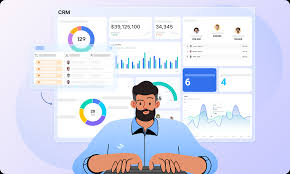
Teamwork between financial advisors is one of the important aspects of providing quality client service and business objectives. Having various advisors collaborate with one another, it is possible to avoid cases of miscommunication when all people are exposed to the same information, which makes work more effective and will contribute to the client’s satisfaction. CRM dashboards have now become a fundamental mechanism of facilitating this co-operation, where advisors are given a centralized location where they can view, update, and access client information, and manage it together. The adoption of the correct tools allows the teams to make the working process more transparent and coordinated.
Shared dashboards are also used to enable the advisors to coordinate their plans and progress towards their goals in real time. Rather than using a piecemeal method of communication, e.g. email or notes, a dashboard will provide a single perspective on client interactions, appointments and other milestones. Such centralization would limit the chances of mistakes and will make tasks performed on time as well as provoke responsibility among the team. To scale collaboration as a financial advisory firm, the shared CRM dashboard is a fundamental part of the scaled collaboration.
Benefits of Centralized Client Information
One of the most short term benefits of shared CRM dashboards is centralized client information. The availability of all the client information, including contact information, portfolio performance and more, in one place means that advisors are able to make quick decisions. Such visibility will guarantee the absence of any critical updates and the full awareness of each team member regarding every client relationship. It is also possible to track the preferences of clients and their history of communication better through a centralized system, which makes communication more personalised and effective.
Shared dashboards enhance efficiency because unnecessary data registration can be minimized. Advisors do not need to make a number of system checks or ask colleagues to give an update. The time-saving ability of being able to view the up-to-date information about clients in real-time is not only time-saving but also a way of ensuring uniformity within the advisory team. This uniformity is especially essential when two or more advisors deal with the same customer since it will avoid confusion and make it clear that one is being professional and organized.
Enhancing Communication Among Advisors
Shared CRM dashboards would aid a stronger communication between advisors as they can have one source of truth. Notes, progress reports, and reminders could be left on the dashboard as well instead of using informal updates or meetings to communicate with the advisor. This combined strategy enables members of the team to be aware of the interactions with the clients and the internal processes without frequent back-and-forth communication.
Proactive collaboration is also facilitated by the use of shared dashboards. The advisors would be able to recognize the possibility of joint client meetings, follow-ups, and make sure that any pressing matters are resolved as quickly as possible. The teams can also avoid miscommunication and duplication of efforts by ensuring that there is transparency on what each other is doing. The dashboard is used as a team work environment where accountability is encouraged and a team work culture is developed in the advisory firm.
Supporting Decision Making
Shared dashboards give decision-making tools and visualization that improve decision making. The consolidating of client data on a single platform provides advisors with an opportunity to discover trends fast and determine the performance of a portfolio, as well as the needs of clients. This real-time understanding will allow teams to make informed decisions in a more efficient way, enhancing end-results of clients and business results.
It is also possible to monitor team performance with the help of shared dashboards. Managers are able to measure the progress towards the objectives, spot the bottlenecks, and make sure that resources are distributed in an efficient manner. Such a degree of supervision will facilitate superior decision making as well as enhance the general working frame of the advisory practice. Through an appropriate dashboard configuration, an advisor will have more time to provide strategic support to clients, as opposed to wasting time finding information.
Integration with Other Tools
Newer shared CRM for financial advisors enables the data of the portfolio management systems, their marketing tools and scheduling software to freely find their way into the dashboard. These systems decrease the amount of manual work and provide an overall picture to the advisors as they integrate the systems.
Through a dashboard that is linked with the already existing tools, teams will be able to automate repetitive duties and keep data synchronized across platforms. This combination makes the collaboration more effective as it ensures that all people are on the same wave and helps to minimize the chance of mistakes. By using the most appropriate CRM software with high integration functionality, the financial advisory firms will be in a better position to ensure an efficient, coordinated and scalable advisory process.
Choosing the Right Dashboard
To achieve the maximum collaboration, it is necessary to select the appropriate shared CRM dashboard. Dashboard tools ought to be considered by advisors in terms of usability, customization, reporting, and integration possibilities. An effective dashboard helps the team members to find information user-friendly, easily visualize its key metrics, and cooperate with each other without the need of advanced training or technical assistance.
The selected solution must also match the workflow and style of client management of the firm. A shared dashboard is not the only way to choose the best CRM software to assist financial advisors; it should also have the means to manage information and comply with security and regulations. By investing in the appropriate platform, it will be possible to make collaboration activities sustainable and allow advisors to develop their teamwork in the long run.
Conclusion
Shared/CRM dashboards In financial advisory teams, advisor collaboration would be better and more efficient due to the ability of new CRM dashboards to improve communication and decision making inside the advisory group. Dashboards will facilitate excellent client outcomes and operational performance by centralizing client data, delivering real-time data, and integrating with other tools, which create a collaborative environment. The financial advisory firms which invest in the most suitable CRM software and adopt shared dashboards position themselves to realize higher productivity and provide more coordinated and high-quality service to its clients.
It is no longer a choice to use CRM to enable financial advisors to have shared visibility and work as a team. It has now become a vital part of contemporary advisory operations that want to expand and remain in close relationships with its clients and excellence in its operations.
About the Author