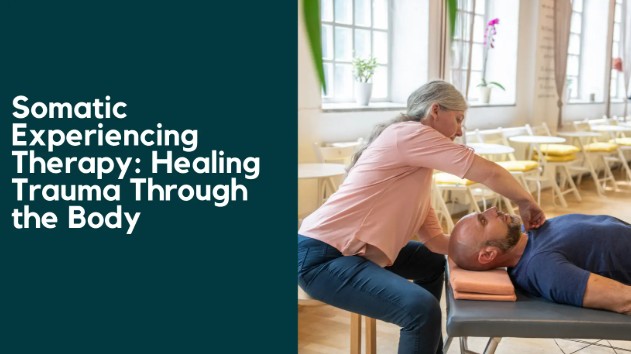
You put in the effort. Possibly years of talk therapy. You can list your triggers, track your behaviors to your youth, explain in detail to anyone what explains your response. However, your body remains in a panic at the supermarket counter, is unresponsive to your partner during a dispute, or refuses to let you rest for over four hours per night. You realize that your trauma and its solution are two distinct things. Somatic experiencing can be found in that space and this is the reason why a large number of individuals determine it to be essential after they have run out of conventional talk therapy.
Trauma Lives in the Body, Not Just the Story
Bessel van der Kolk’s research, as summarized in his book The Body Keeps the Score, basically demonstrated something most clinicians at this point believe: traumatic experience comes along for the body’s ride. Long after you’ve consciously forgotten the details or consciously changed the story, things like muscle tension, breath patterns, heart rate variability, and startle response continue to bear the imprint of that long-ago event. (Or of those long-ago many events.)
And it’s not a tiny, unlucky subpopulation that’s impacted by this. CDC surveillance data shows that nearly two-thirds of U.S. adults, roughly 64%, report at least one ACE, or adverse childhood event, and the more ACEs you rack up, the likelier you are, in a fairly linear way, to struggle with heart disease, cancer, diabetes, addiction, depression, and suicide, among other conditions, later in life as well as with an overuse of medical, mental health, and social services. In other words, a majority of Americans have faced a mainstream public health issue, and it’s not only toxic workplaces that can’t take the blame for everyone’s unspooling; it’s not only plain old lack of resilience. It’s that the body remembers.
Why Animals Shake it Off and Humans Don’t
The founder of Somatic Experiencing®, Peter Levine based his entire model on a single observation from the natural world. See a gazelle narrowly escape a predator. It trembles, shakes, sometimes convulses for a few seconds, and then goes back to grazing as if nothing happened. The shaking is the nervous system discharging the enormous survival energy that got mobilized during the chase. Once discharged, the threat response resets and completes itself.
We rarely get to complete that cycle. We suppress the shake because it looks weird, or because we’re supposed to keep it together, or because the threat was psychological and there was no clear moment of escape to trigger release. The survival energy of that fight, flight, or freeze response stays mobilized inside the nervous system with nowhere to go. Levine argues that it is this, not the memory of the event itself, that produces chronic dysregulation years or decades later.
Where SE Fits Inside a Full Treatment Plan
Somatic experiencing should be used as part of an overall treatment plan and not as a standalone solution. Trauma is often accompanied by other conditions such as substance use, depression, anxiety disorders, and medical issues. It’s important to treat the nervous system in conjunction with these other aspects in order to have lasting results.
An integrated care approach that includes SE bottom-up therapy, psychiatric treatment, psychotherapy, and aftercare planning is essential for the nervous system to develop proper regulation along with stabilization and prevention of medical and psychiatric issues. Facilities like Legacy Healing LA intentionally combine somatic therapy with the necessary psychiatric and medical treatment for patients dealing with trauma and other co-occurring conditions. The right mix is more important than any single tool or modality, as a nervous system may be regulated during therapy sessions, but if it is sent back to an unmanaged medical or psychiatric crisis the benefits are likely to be lost.
The Ceiling on Talk Therapy
Cognitive approaches and narrative therapy are very helpful tools. They help to integrate what happened, question distorted beliefs that arose because of trauma and build a story of one’s life that is less fragmented by the effects of traumatic experience. However, these therapies work through top-down processing, using the thinking brain, making meaning, and engaging with the world in a cognitive sense. Trauma responses are located lower in the brain, and while language and logic can help people manage those responses, they are less effective in resolving them.
This is why therapists hear the phrase “I know” so often in sessions with clients who have experienced trauma. They can talk through the narrative of what happened and why, and understand all the components of it, but they’re still stuck with the racing heart or the clenched jaw or the wave of dissociation that hits in response to the smallest cue. The thinking brain has processed the information successfully, but the nervous system has not got the message and the body is still stuck in its conditioned survival response.
Tracking Sensation Instead of Storyline
Somatic experiencing functions differently and takes another approach. Instead of inquiring “what happened and what did it mean”, a SE practitioner inquires “what’s happening in your body right now?” This relies on Eugene Gendlin’s implementation of the felt sense, that is, the unclear, pre-verbal body-level consciousness below language. Clients learn to cultivate interoception, which is the ability to perceive internal sensations such as tightness, temperature, weight, or tingling, and to determine how they change from one moment to the next.
The therapist follows the body rather than the plot. A client may talk about a car accident and the practitioner notices their breath has caught and their shoulders have tensed up. The work is right there, in that sensation, not in the following sentence in the story. This is bottom-up processing: regulate the nervous system first, and get cognitive insight, if it comes, as a side effect rather than a direct goal.
Titration and Pendulation: The Pacing That Prevents Harm
SE can work with traumatic material because of two specific mechanisms. Titration means introducing charged activation in small amounts that are tolerable to the individual. Pendulation is the deliberate oscillation between a moment of activation and a moment of settling, the therapist supports this oscillation, helping the client’s system begin to process the activation in a containable way by using resources.
Over repeated sessions, this rhythm builds capacity. It’s similar to strength training: you don’t build muscle by holding maximum weight indefinitely, you build it through controlled reps with recovery between them. Pendulation does the same thing for nervous system tolerance. Each cycle of activation-and-return teaches the body that it can approach the edge of distress and come back safely, which is precisely the lesson that got interrupted when the original trauma occurred without resolution.
This pacing is also SE’s built-in safeguard against retraumatization, a serious risk in any therapy that engages traumatic material directly. Practitioners are trained to watch for signs that a client is approaching overwhelm and to slow down or pull back before that threshold is crossed.
Widening the Window of Tolerance
Dan Siegel talks about a “window of tolerance”. It means the zone of arousal a person can function in but also think rationally and stay present. Dysregulation manifests when someone goes outside that window, and it goes in one of two ways: Hyperarousal is characterized by panic, rage, lots of thoughts rushing in, or an inability to sleep. Hypoarousal presents as numbness, dissociation, extreme tiredness, or even collapse. Most trauma patients go from one to the other, and spend little time in the regulated state.
The long-term objective of SE is to widen this window. By experiencing pendulation and titration, little by little, patients create a wider margin of arousal they can handle before going into either of the extremes. This isn’t a one-time session, “a-ha” moment type of thing. It’s a slow and building process, which is also one of the reasons why SE interventions are usually months rather than weeks long.
Safety Before Anything Else
One of the most important, and most frequently overlooked, features of somatic experiencing is that it is resourcing-first. Before any traumatic material gets approached, the practitioner works with the client to establish internal and external anchors of safety: a steadying breath pattern, a comforting memory, a supportive relationship, a physical sensation of groundedness in the feet or the chair. These resources become the anchor the client returns to during pendulation.
This stands in contrast to more confrontation-oriented trauma models that ask clients to engage difficult material head-on, quickly, with the assumption that exposure itself is therapeutic. SE’s practitioners generally view that approach as carrying too much risk of flooding an already dysregulated nervous system. Resourcing isn’t a warm-up exercise tacked onto the beginning of treatment. It’s the foundation the entire process rests on.
What the Evidence Actually Shows
Somatic Experiencing is not just an interesting theory. Clinical studies have shown that patients treated with SE have experienced a significant reduction in the severity of their symptoms. While the evidence base is not as broad as for other types of treatment like cognitive processing therapy, it is growing. The clinical observations reported align well with the broader science of polyvagal theory. Current research highlights how the nervous system is constantly noting, and responding to, cues of safety and danger in the environment.
So, what is SE not? It is not intended to replace psychiatric care, medication, or psychotherapy. It is an adjunct, specifically focusing on the most neglected layer, the physiological layer. To depict SE as a cure-all is far too much. To depict it as an alternative fringy treatment is much too little.
Finding the Right Practitioner
Credentials are important if you’re working with a dysregulated nervous system, as in SE. Look for a Somatic Experiencing Practitioner, or SEP, indicating completion of the multi-year training program developed through the Somatic Experiencing Trauma Institute. This should ideally occur under trauma-informed clinical supervision in a facility that’s able to manage co-occurring psychiatric or medical needs in case they emerge during treatment.
Body-held trauma that’s been stuck for years doesn’t resolve because someone finally understands it intellectually. It resolves when the nervous system itself gets a chance to complete what it never finished. This is a different sort of work than talk therapy, and for many people, it’s the missing piece.
Write and Win: Participate in Creative writing Contest & International Essay Contest and win fabulous prizes.
About the Author