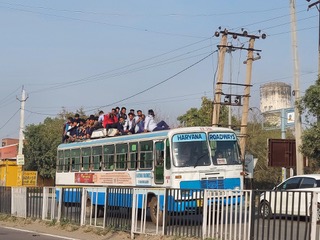
In August 2018, Kerala’s Motor Vehicle Department told roughly 18000 school bus operators across the state to install AIS 140 compliant GPS tracking devices or lose their permits. The Suraksha Mitr platform, built by C-DAC, came online on October 16 that year, and the idea was simple enough on paper. Every school bus transmits its location, speed, and route to a government server, and parents get to see where their children are. The political energy behind it had been building for years through a string of incidents involving school transport and public buses, most of them involving the safety of women and children, none of them individually decisive but collectively impossible for the state government to keep deflecting.
Parents wanted to know where the bus was at all times, the state government wanted a panic button hardwired into every vehicle that carried passengers, and Transport Commissioner K. Padmakumar had both the political backing and a tech ecosystem around Thiruvananthapuram willing to build the backend. What strikes me now, looking at the 2018 rollout from eight years out, is that almost nobody in the public debate asked the obvious next question. If you build an architecture for tracking school buses that works this well and the state already has the servers running, what exactly stops it from being extended to every other commercial vehicle on the road. The answer turned out to be nothing.
Once the school bus mandate proved that the infrastructure worked, the scope expanded at a pace that caught a lot of fleet operators off guard. Public transport buses came under AIS 140 in 2018, the full public transport sector in April 2019, and by August 2022 MoRTH had pulled N2 and N3 goods vehicles and hazardous goods carriers into the requirement as well. By late 2025, the mandate covered goods carriers, taxis, tourist buses, autorickshaws in some states, ambulances, employee transport, basically everything on Indian roads with a yellow number plate. Private white plate vehicles were left out.
The enforcement deadline that passed over the last year pushed compliance into 2026 for most operators. The hardware itself is not a consumer GPS unit with a SIM card jammed into it. Dual constellation GNSS is mandatory. GPS plus NavIC, and NavIC is ISRO’s own satellite navigation system, is required in AIS 140 devices since April 1 2021. On top of that, every device needs a panic button wired to state control rooms, tamper detection, four hours of battery backup, simultaneous data transmission to two IP addresses, 90 days of onboard storage, and ARAI or ICAT type approval. The NavIC requirement is interesting for reasons that have nothing to do with how well the device navigates. What India actually accomplished through AIS 140 is embedding its own ISRO built satellite constellation into every compliant commercial vehicle in the country, which is a piece of industrial sovereignty policy that rode in on the back of a road safety regulation and attracted almost no public scrutiny as it happened.
India’s fleet telematics installed base was projected to hit roughly 6.8 million units by 2025, up from 3.5 million in 2020, and the market runs between 1.4 and 1.7 billion dollars in 2025 depending on who is sizing it, headed toward 3 to 4.35 billion by 2030-2032. Fleet and logistics management accounts for around 42 percent of telematics revenue. That is a commercial market, obviously, but it is also a description of monitoring infrastructure that covers several million working vehicles and the people driving them, infrastructure that simply was not there ten years ago. Telematics data shows that the closest comparison internationally is the EU’s eCall system, and eCall is narrower in every dimension. eCall wakes up when a vehicle crashes and goes back to sleep afterward, while AIS 140 transmits location data to a state server continuously, whether the vehicle is involved in an accident or just sitting outside a tea stall in Thrissur with the engine idling.
When the mandate was argued for publicly, the panic button did most of the rhetorical work. A woman alone in a cab past midnight, a child on a school bus that turns off its assigned route, a passenger having a cardiac event on a state transport bus somewhere on NH 66. Those scenarios are not invented. The panic button matters in all of them. Indian national and state highways make up just over 5 percent of total road length but carry more than 61 percent of traffic fatalities according to government data, and nobody with any seriousness is going to argue that real time emergency response on those roads is unnecessary. But the panic button gets pressed maybe a handful of times across a fleet in any given year. The tracking, on the other hand, never stops. When a commercial vehicle reports its coordinates to a government server every few seconds around the clock, the dataset that accumulates over weeks and months has very little to do with emergencies anymore. It is a complete, timestamped record of everywhere the driver went, how long he stopped at each location, what speed he held between Kolhapur and Sangli, whether he took the planned route or went off it, and whether the 35 minute break he took at a fuel station on NH 48 was authorized or not.
What fleet owners actually do with AIS 140 data goes considerably past anything the child safety framing anticipated. Remote immobilization is live on compliant devices now, meaning the owner or the government can kill the vehicle remotely if it is reported stolen. The same device that has the panic button wired into it can also kill the vehicle’s engine remotely on a command from the owner or from the state. Driver behavior scoring came along with the telematics platforms almost as a default feature, and now most of them track harsh braking, rapid acceleration, speeding, and idling time and pipe that data into HR dashboards where it shows up next to the driver’s name and feeds into warnings, bonus calculations, and termination decisions.
A dispatcher in Pune can see that a truck has been parked at a dhaba outside Satara for 45 minutes when the route plan allowed 20, and he picks up the phone. The fleet management companies selling these platforms are not shy about any of this, it is the product. Insurers cut premiums for AIS 140 equipped vehicles, several state governments offer partial GST exemptions on the tracking hardware, and between the two the financial incentive structure pushes adoption well past what the regulation alone would produce. The driver, who was already doing one of the hardest and worst compensated jobs in Indian transport, now does it under permanent location monitoring with a behavior score attached to his name that his employer built and his employer interprets, and the origin point for all of it was a 2018 initiative to keep children safe on school buses.
I do not have a clean verdict on any of this, and I am wary of the commentators who seem to. The safety record improved, the emergency response works, stolen vehicles get recovered faster, and the route compliance data gives state transport authorities something usable when they are deciding which highway stretches need engineering attention. But the thing I cannot stop circling back to is who was in the room when all of this got designed. The drivers were not. The millions of people feeding their location into these servers every few seconds of every working day had no seat at any table where the architecture took shape. Vehicle owners decided what they wanted to see, regulators set what they needed enforced, parents demanded accountability after the school bus incidents, and the driver ended up as the person being watched by a system he had no part in shaping.
I have had this conversation with drivers across several Indian states and the frustration tracks almost exactly with what transport workers say in Europe and the US when telematics mandates land from above. The technology was not designed with the driver as a stakeholder. It was designed with the driver as a subject. Kerala launched Suraksha Mitr to protect children on school buses, and eight years later the same backend infrastructure tracks millions of goods vehicles across the country. The panic button that parents asked for became the always on tracking system that fleet owners use to monitor bathroom breaks. Neither outcome was inevitable, but both followed logically from the architecture that was chosen in 2018, and nobody who was paying attention to how these systems get deployed should be surprised by where it ended up.
About the Author