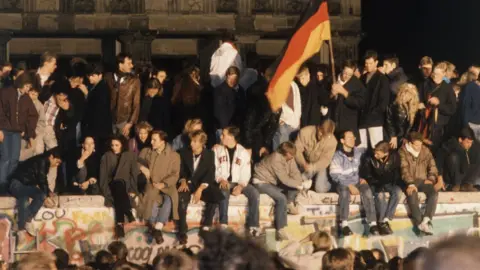
On the 9th of November 1989, crowds gathered at the Berlin Wall. Confused border guards stood aside as people crossed freely for the first time in decades. Within hours, citizens climbed and broke apart the barrier that had divided Europe.
The year was 1945. The reign of the Moustache Man (Adolf Hitler) was over. Europe was devastated by World War II. The Cold War had started. The USSR had established pro-Soviet communist governments across Eastern Europe. The Eastern Bloc was formed by the USSR, including Albania, Bulgaria, Czechoslovakia, East Germany, Hungary, Poland, Romania, Yugoslavia and of course, the USSR. These communist governments controlled the economy and its people like puppets. The citizens had limited political freedom. Though elections were held, the people had no actual power to vote. By 1989, the system faced a deep economic and political crisis and was was in deep crisis and had lost public trust. The fall of communism in Eastern Europe resulted from economic failure, loss of legitimacy and mass protests.
The communist ideology strongly promoted state ownership of industry and central planning. The governments set strict production targets through the Five-Year plans. Prices did not reflect the supply and demand, but reflected the government’s wishes. All the political power lay in the hands of a single ruling party. The secret police enforced loyalty to the regime and suppressed all actions against it. The communist Rome (Soviet Union) guaranteed military support to the Warsaw Pact members, which actually meant the puppet governments put on by the Soviet Union. This system removed incentives for efficiency. Managers focused on meeting state targets rather than solving real problems. Innovation slowed because success did not depend on creativity or competition. Over time, industries became outdated and unable to match Western standards.
The economies of these nations were in ruins. The high involvement of the central government in the economy reduced the efficiency and innovation of the nation. The only factories that existed were extremely focused on meeting quotas rather than improving the quality. Consumer goods were scarce across the region. Waitlists as long as 10 to 20 years existed for houses, cars and other ‘luxury’ products. A worker often saved money for years but still could not buy basic goods. Shops ran out of items within hours of delivery. Long queues became part of daily life. This constant shortage created frustration that went beyond economics and affected trust in the system. Foreign debt skyrocketed in Poland and Hungary during the 1970s. Poland’s foreign debt rose above 40 billion dollars by the 1980s. Growth in both countries was below two per cent in the 1980s. Economic growth was slower than a tortoise in the 1980s. The standard of living was behind by a mile compared to their Western counterparts. Citizens compared their lives with those in the West through television and the radio. In Western Europe, incomes rose, goods are widely available and political freedom was stronger. A worker would wait years for a car while factories focused only on meeting production targets.
In the age when most of the world had a strong 4th pillar, the media, the governments of Eastern Europe heavily restricted free speech and censored most of the media. The secret police monitored the people in all aspects of life, and informants spread fear all around the region. All kinds of travel outside the Warsaw Pact member countries required state approval that took ages. Anyone who tried to challenge the regime faced arrests and strict interrogation. Many citizens publicly complied with the ideology but privately despised the system. The gap between state propaganda and daily life was as wide as a mile. In many cases, citizens learned to read between the lines of official news. Jokes about the government spread quietly as a form of resistance. These small acts showed that belief in the system had already weakened.
The Berlin Wall was the true symbol of the Iron Curtain and communist supremacy. It was built in 1961 to stop East German citizens from fleeing to West Germany. From 1945 to 1961, around 3 million East Germans fled the country before the construction of the Wall. The Wall symbolised the divide and hatred between communist and capitalist governments. Armed guards and checkpoints strictly enforced the border. Those who still tried to cross the border faced death and only death as a punishment. On the 9th of November 1989, the people forced the wall open after a slip of words by the regime’s representative in a press meeting. The fall of the Berlin Wall became the start of the collapse of communism in Eastern Europe. The wall also became a global symbol of the Cold War. Its existence showed the physical separation between two opposing systems. Its fall, therefore, carried meaning far beyond Germany.
Mikhail Gorbachev was the person who struck the final nail in the coffin. He became the General Secretary of the communist party of the Soviet Union (a.k.a. the President) in 1985. He introduced ‘Perestroika’ and ‘Glasnost’, which meant to reform the economy and increase openness. These reforms failed to revive the economy and instead exposed its weaknesses. He reduced state censorship and encouraged debate. Greater openness allowed criticism to spread, weakening the authority of the government. He signalled that the USSR would not use force to support its puppet regimes. But all of these showed the true face of the Soviet Union and communism, and the people revolted to get basic rights. These policies weakened hardline communist leaders across the region. By refusing to send troops into Eastern Europe, he broke from past soviet policy. Earlier uprisings in Hungary in 1956 and Czechoslovakia in 1968 had been crushed by force. This time, no such interventions came.
In 1980, workers of Gdansk, a city in Poland, created the Solidarity Trade Union. This union demanded rights for the workers and political reforms. In a short time, membership grew to a whopping 10 million. The communist government of Poland imposed martial law in 1981 to suppress opposition and destroy the association. But the Solidarity survived secretly underground during the 1980s. In 1989, Solidarity forced the government to agree to round table talks, leading to partially free elections. Solidarity won the election by a huge margin and formed the first democratic government in the region after a long time. This success encouraged similar movements across other Eastern European countries. The success of the solidarity showed showed that change was possible without violent revolution. It gave hope to people across the region who had long believed that resistance would fail.
Change spread quickly across the region, from Poland to Hungary, East Germany, Czechoslovakia and Romania. In 1989, weekly demonstrations began in Leipzig, a city of East Germany. These peaceful protesters demanded free travel and democratic reforms. The leadership struggled to control the public anger. Confusion over new travel policies triggered crowds at border crossings. On 9 November 1989, the public pried the Berlin Wall open. At last, both Germanies were reunified in October 1990.
In November 1989, inspired by the Solidarity of Poland, student protests began in Prague, the capital of Czechoslovakia. Police violence against the protesters increased public outrage. Mass demonstrations against the regime filled the city square. The leadership of Czechoslovakia could not handle the pressure, and the Communist Party resigned within weeks of the protests. Vaclav Havel, the leader of the protests, was elected president after the revolution. Later, it was known as the Velvet Revolution.
During the Cold War era, Nicolae Ceaușescu ruled Romania with an iron fist as the leader of the Communist Party in Romania. But in the 1980s, economic hardships intensified public frustration. The first protests started in Timisoara in December 1989. The army, which kept the regime alive for 40 years denied to continue supporting the regime against the protesters. Ceaușescu attempted to flee the country, but authorities captured and executed him after a rapid trial. Romania’s revolution involved significantly more violence than those of other countries.
Communist parties lost power across Europe by 1990. These countries introduced multiparty elections and market reforms. In the end, the communist Rome, the Soviet Union, fell in 1991. 15 independent countries emerged from the fallen USSR.
After the fall of communism, many former Warsaw Pact members joined NATO for protection against Russia. Several also joined the European Union in 2004 and later. Market reforms by the new democratic governments reshaped the national economies. The collapse of the Soviet Union also led to the rise of the Russian Federation as a new power in global politics under the rule of Vladimir Putin, a former KGB spy. The living standards improved over the years, while inequality increased. Political debates about the communist past continue even today in the region.
The fall of communism in Eastern Europe reshaped global politics forever. The economic weakness and political repression eroded the communist system from within. The public protests transformed long-term frustration into action. The reforms of the Soviet Union removed the threat of military force. These events of 1989 ended decades of division in Europe. These changes also marked the shift from a divided Europe to a more connected one. Borders opened, economies integrated, and political systems changed within a short span of time.
By: Shlok Mokal
Write and Win: Participate in Creative writing Contest & International Essay Contest and win fabulous prizes.
About the Author